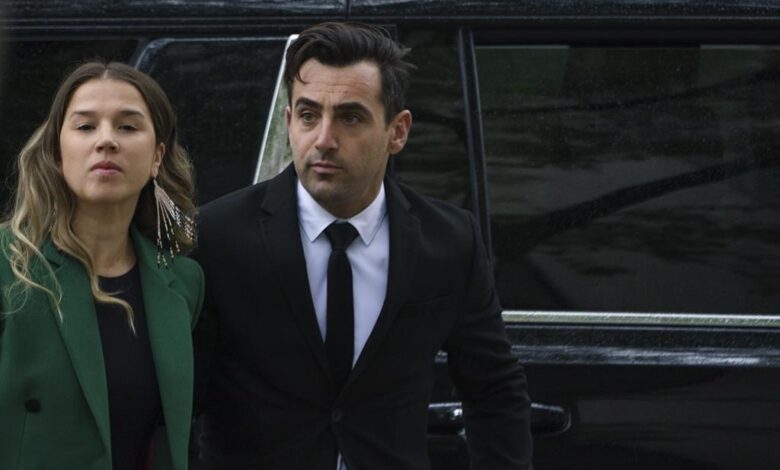
Ontario Superior Court Justice Robin Tremblay delivered final instructions to the jury in Jacob Hoggard’s northeastern Ontario sexual-assault trial on October 4, 2024. Jurors returned a not-guilty verdict later that day after deliberating for less than six hours.
The case concerned a 2016 encounter
Hoggard, the former lead singer of Hedley, pleaded not guilty to one count of sexual assault arising from an encounter in a Kirkland Lake hotel room. The complainant was 19 at the time and her identity was protected by a publication ban.
Both sides agreed that sexual activity occurred after a social gathering. They presented sharply different accounts of whether the complainant consented and whether Hoggard knew she did not consent.
The complainant and accused both testified
The woman said she repeatedly resisted and was afraid. Hoggard said the encounter was consensual and denied using force or ignoring objections.
The Crown called the complainant as its only witness, while Hoggard testified for the defence. A witness count does not determine credibility; a jury must evaluate the evidence under the same criminal standard regardless of how many people testify.
The judge explained the legal questions
Tremblay told jurors that a conviction required proof beyond a reasonable doubt that the complainant did not voluntarily agree to at least one sexual activity at issue and that Hoggard knew she did not agree, was reckless or was wilfully blind.
Consent is assessed through the complainant’s subjective state at the time. The law does not recognize implied consent, and an accused who relies on a mistaken belief must have taken reasonable steps in the circumstances.
An acquittal followed the instructions
The unanimous verdict meant the Crown had not proved every element beyond a reasonable doubt. It did not require jurors to declare that every defence statement was true or that the complainant fabricated her account.
This distinction is essential in sexual-assault coverage. “Not guilty” is the legal result and must be reported without turning the criminal burden of proof into a public finding against the complainant.
A separate conviction was kept from the jury
Jurors did not hear that a Toronto jury had convicted Hoggard in 2022 of sexual assault causing bodily harm against another woman in an unrelated case. Evidence of a prior conviction can be unfairly prejudicial and was excluded from the northeastern Ontario trial.
The Toronto conviction and five-year sentence remained in force. The Ontario Court of Appeal had upheld it in August 2024, and Hoggard was already serving that sentence while attending the new trial.
The two outcomes were not contradictory verdicts
Each prosecution involved a different complainant, event and evidentiary record. The acquittal in Kirkland Lake did not overturn the Toronto conviction, while the conviction could not be used as proof that he committed the separate charged offence.
On the day of the acquittal, Hoggard discontinued his application for leave to appeal the Toronto case to the Supreme Court of Canada. The court file was then closed.
Careful language protects the record
Before deliberations, the accurate description was that Hoggard was charged and denied the allegation. After the verdict, the article also had to state clearly that he was acquitted.
The final record therefore contains three distinct facts: the judge instructed jurors on consent and reasonable doubt, the jury found Hoggard not guilty in this case, and he continued serving a sentence for a separate conviction. Keeping those facts separate respects both due process and the complainants affected by each proceeding.