
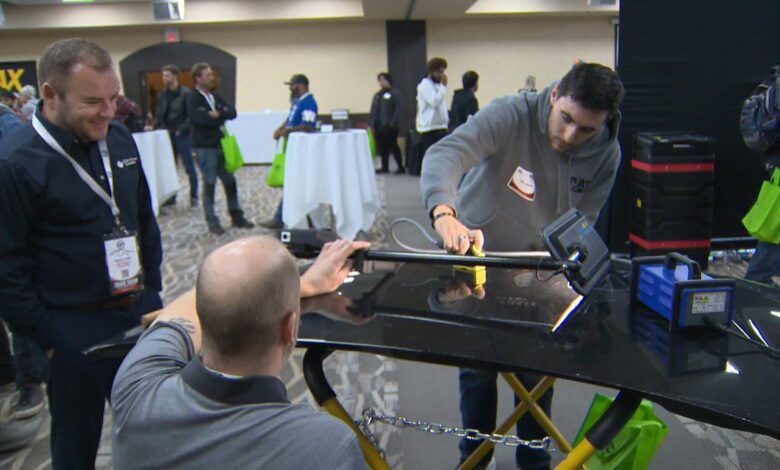
Hundreds of Manitoba high-school students explored automotive careers at an industry trade show in Winnipeg on October 4, 2024. The event presented collision repair as a field combining skilled manual work with software, electronics, calibration and customer service.
Attendance tripled from the previous year
The Automotive Trades Association of Manitoba invited 365 students and teachers from across the province to its annual show at Canad Inns Polo Park. Organizers said the youth component drew about three times the previous attendance after earlier outreach to schools.
Bringing students into an operating industry event allowed them to question employers, technicians, suppliers and instructors rather than relying only on a classroom description of the trade.
The booths showed a wider range of work
Displays covered dent repair, refinishing, estimating, parts and supply chains, specialized tools, software and vehicle-system calibration. That range challenged the outdated image of automotive work as only mechanical repair.
Modern vehicles integrate cameras, radar, electronic control modules and advanced driver-assistance systems. Repairs may require scanning and calibration so safety functions perform as designed after body work or glass replacement.
Students described hands-on appeal
Recent graduate Samara Baltazar said a school collision-repair and refinishing programme matched her interest in problem-solving and practical work. Red River College Polytechnic autobody student Tyler Wiens said the number of possible paths at the show was eye-opening.
Those perspectives matter because a career decision involves the daily nature of work, not just an advertised wage. Students benefit from seeing both creative finishing tasks and highly structured safety procedures.
Employers reported a technician shortage
Association executive director Denis Cloutier said collision businesses, like many trades, struggled to attract young people. Koos Reineking of Lift Auto Group emphasized that rural employers found it especially difficult to recruit technicians.
A shortage can create opportunity, but employers also influence whether people remain. Competitive pay, paid training, safe shops, respectful supervision, predictable hours and a route from apprentice to certified technician are central to retention.
Technology increases the training burden
Electric vehicles, new materials and connected safety systems require continuous learning. A repair that looks correct can still be unsafe if a sensor is misaligned, high-voltage procedures are ignored or manufacturer specifications are not followed.
Schools and employers therefore need current equipment and instructors. Students should ask whether placements expose them to modern systems, who pays for tools and courses, and how work experience counts toward certification.
Teachers used the show to make careers visible
Collision-repair teacher Greg Oliver hoped that the vendors, materials and equipment would spark interest among his students. The show connected school programmes with an industry many young people encounter as customers but rarely see as a network of specialized occupations.
Career outreach should include women, Indigenous students, newcomers and people with disabilities who have historically faced barriers in some trades. Recruitment without an inclusive workplace merely shifts the problem from entry to retention.
A trade show is a starting point
Employers such as AkzoNobel representative Tom Edwards argued that vehicles and collisions would continue to create repair demand. Long-term forecasts must also account for changing technology, insurance practices and the capital cost of modern shops.
Students need neutral guidance on apprenticeship requirements, physical demands, earnings progression and transferable skills before committing. Hands-on demonstrations can make those questions concrete.
The event joined education with workforce planning
The day’s success was not simply the number through the doors. Its real value would appear in informed programme enrolment, quality apprenticeships and technicians who stay in the industry.
By showing calibration and software beside paint and panel work, the 2024 event presented automotive repair as the evolving technical field it had become. That fuller picture gave students a better basis for deciding whether one of its many roles suited them.



