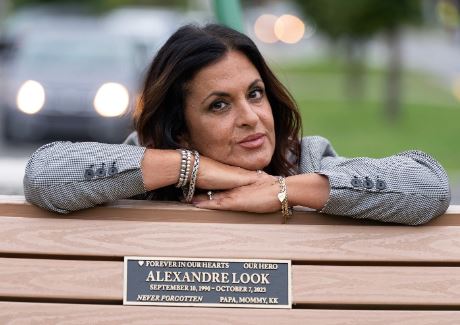
Raquel Ohnona Look marked the first anniversary of her son Alexandre’s death at a small Côte-Saint-Luc green space renamed in his honour. The Montréal native was killed at the Supernova music festival during the Hamas-led attack on Israel on October 7, 2023.
A bench preserves his name
A plaque on a bench at Alexandre Look Place records his life from September 10, 1990, to October 7, 2023, with a message calling him a hero. The site is near the Jewish school he attended and the synagogue where his father prayed.
The family moved back to Côte-Saint-Luc after his death. Neighbours and strangers continued to offer condolences, turning an ordinary public space into a place of community remembrance.
His parents heard the attack unfold
Look, 33, was visiting Israel and attending the outdoor festival when gunmen attacked. He sheltered with about 30 other people and remained on a video call with his parents in Montréal.
His mother described the lasting trauma of hearing gunfire and realizing that her son was in danger while she could not reach him. Such testimony belongs to the family; responsible coverage should not amplify recordings or private details merely for shock.
Survivors described efforts to protect others
Ohnona Look spent months speaking with people who survived the shelter. They told her that Alexandre encouraged others, tried to reason with attackers and positioned himself near the front.
A first responder later told the family he was found over two people he had tried to protect. Calling him a hero reflected testimony the family received and their understanding of his conduct, not a reason to turn the deaths of others into background scenery.
A life extended beyond its final minutes
Look spoke six languages, had worked in sales and was living in Cabo San Lucas, Mexico. His mother described a large personality and a person guided by generosity.
Profiles of victims should include ordinary work, relationships and ambitions. Defining someone only by the violence that killed them grants the attacker too much control over the public memory.
The attack killed people with Canadian ties
Look was among at least eight Canadian citizens or people with close Canadian connections killed on October 7. Other victims included Winnipeg-born peace activist Vivian Silver and young people from Vancouver and Israeli-Canadian families.
Some bodies were taken into Gaza, leaving families without burial and certainty. Hostage-taking is prohibited under international humanitarian law, and families continued pressing governments for the return of living captives and remains.
Grief existed beside a devastating war
The Hamas-led attack killed about 1,200 people in Israel and triggered an Israeli campaign that had killed more than 41,000 Palestinians by the first anniversary, according to Gaza health authorities. Most of Gaza’s population had been displaced.
Those facts do not compete with one family’s story. Mourning Alexandre does not diminish Palestinian civilians, and recognizing Palestinian suffering does not reduce the crime committed against festival-goers.
Memory became public action
Ohnona Look said she entered “warrior mode,” speaking against antisemitism and for hostages and victims she feared would be forgotten. Advocacy can give grief a direction, though no public role removes private loss.
The renamed place cannot restore the family that existed before October 7. It can preserve a fuller record: Alexandre Look was a Montréal son, multilingual worker and protector remembered by survivors—not merely one number in an attack whose consequences continued to divide and wound communities far beyond Israel and Gaza.