
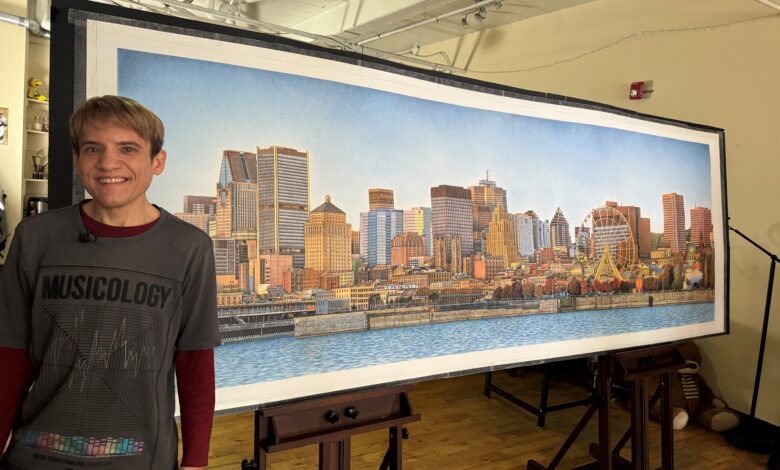
Montréal artist Casey Vormer completed a 10-foot coloured-pencil panorama of Old Montréal after roughly 900 hours of work. The Dutch-born artist, who is autistic, documented the demanding project online and sold it to a collector in the United Kingdom for more than $60,000.
A cityscape built through detail
Vormer’s drawing depicted the Old Montréal skyline with enough precision that viewers could initially mistake parts for a photograph. Its scale allowed architecture, rooflines and streets to become an extended visual narrative rather than a single landmark study.
He described finishing it as an achievement accompanied by relief. A project lasting hundreds of hours included satisfaction, attachment and periods of intense frustration.
An audience watched the work develop
Vormer shared progress on social media, where he had attracted hundreds of thousands of followers. Thousands of people followed the image as it emerged, giving a private studio process a public rhythm.
A British collector agreed to buy the work before completion. That early commitment provided commercial validation but also created the pressure of finishing a highly visible commission.
Drawing offered safety from childhood
Vormer said he began drawing cartoon characters and animals as a toddler. Art provided an escape from loneliness and difficult social interaction, allowing him to build an environment that felt predictable and safe.
He was diagnosed with autism at 21 and described the diagnosis as a relief after a challenging adolescence. It gave context to difficulties that had affected his self-esteem rather than changing who he was.
Success did not erase disability
By 2024, Vormer had supported himself entirely through art for about five years. At the same time, he said grocery shopping, prioritizing tasks, communicating with customers and combining daily responsibilities could become overwhelming.
Those experiences challenge a common media pattern in which an exceptional artwork is used to imply that talent conquers disability. Professional success and support needs can exist together.
Autistic adults face a support gap
Vormer relied on a close circle of friends. One supporter noted that autism services frequently focus on children, leaving adults with fewer resources for daily living, employment and social participation.
Useful support is individualized. It can include accessible communication, predictable scheduling, help with administration or sensory needs, without taking control away from the artist or assuming every autistic person works in the same way.
The artist should remain central
Calling autism a “superpower” may sound complimentary, but it can flatten both skill and difficulty into a stereotype. Vormer’s work came from practice, artistic judgment and sustained labour. Autism was part of his life and perspective, not a substitute explanation for craft.
Coverage should also avoid describing an adult as childlike or inspirational merely for working. The relevant achievement was specific: a technically ambitious drawing, a viable art career and an artist speaking directly about his experience.
Acceptance enabled better work
Vormer said it was important to be surrounded by people and an environment that accepted him. That observation applies beyond art: inclusion is not asking a person to hide support needs in exchange for opportunity.
The Old Montréal panorama became a milestone because of its scale, detail, time and emotional investment. Its strongest story was not that an autistic person had done something surprising. It was that a working artist set an extraordinary challenge, found an audience and completed it while honestly describing both his ability and the support that made his career sustainable.



