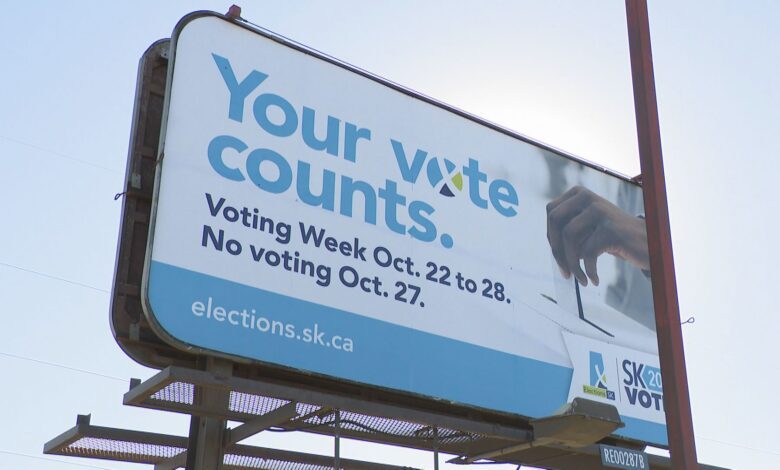
Saskatchewan’s 2024 provincial election replaced the traditional emphasis on one election day with a six-day “Voting Week.” Eligible voters could cast ballots on five consecutive early days from October 22 to 26 and on the final voting day, October 28, with no voting on Sunday, October 27.
Dates and hours
Elections Saskatchewan scheduled voting from 10 a.m. to 7 p.m. on each of the first five days, one additional hour per day compared with earlier advance polls. On October 28, locations opened from 9 a.m. to 8 p.m. In total, the agency advertised 56 hours of in-person voting.
The pause on October 27 supported administrative consistency and the transition to the larger set of final-day locations. Voters still needed to use an authorized location in their constituency and follow identification requirements; “Voting Week” did not mean unrestricted voting at any location in the province.
Who was eligible
A voter had to be a Canadian citizen, at least 18 years old by October 28 and ordinarily resident in Saskatchewan. People who missed advance registration could register in person when voting with the required identification. Voter information cards helped identify assigned locations but were not the ballot itself.
Vote-by-mail and homebound options were also available through advance applications and deadlines. Mail ballots followed a later counting timetable, so preliminary results on the final night did not necessarily include every valid ballot.
Why the system changed
The independent election agency said the model placed voters at the centre by providing more days, longer hours and multiple methods. It also used electronic poll books and barcode scanners in many locations to serve voters through a “bank teller” approach within assigned areas, while retaining paper ballots and formal counting controls.
Convenience can improve access for shift workers, caregivers, students and people affected by travel or weather. It does not guarantee higher total turnout, because political interest, competitiveness, registration and public trust also influence participation.
Counting and integrity
The first preliminary count began after polls closed on October 28 and included Voting Week, personal-care-facility and homebound ballots. Later stages counted eligible mail and other special ballots. Multiple count dates are a planned part of the process, not evidence that results are being secretly changed.
Election workers reconcile issued and returned ballots, voter records and results. Electronic poll books assist with administration, but the vote itself remained on paper. Candidates and parties can appoint representatives to observe permitted parts of voting and counting.
Historical outcome of the experiment
Elections Saskatchewan later described 2024 as the province’s first formal Voting Week. Its figures show 273,010 votes across the first five days, compared with 184,742 advance votes in 2020, although changes in access and circumstances mean that raw totals alone do not prove cause.
The model’s key innovation was not six consecutive days; it was five voting days, a one-day administrative pause and a final day. Accurate dates remain important when explaining how Saskatchewan’s 30th general election was run.
Anyone studying turnout should compare final eligible-voter totals and all voting methods, not only the five-day early count. A busier advance period can partly reflect voters shifting the day they cast a ballot rather than a net increase in participation.