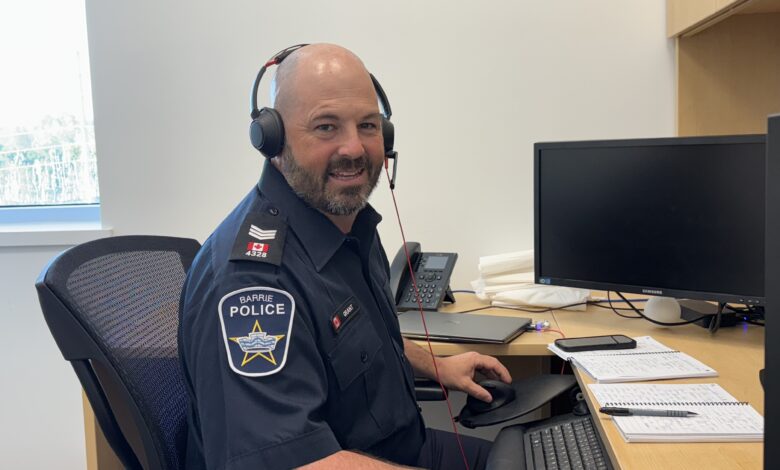
Barrie Police launched a Virtual Call Response pilot in September 2024, giving eligible non-emergency callers the option to speak face to face with an officer through secure video. London Police had already tested a related model for non-urgent intimate-partner-violence reports.
How Barrie’s pilot worked
A call taker first assessed whether there was an immediate threat to a person or property. If the incident was suitable and the caller had a smartphone, Sergeant Bill Grant could offer a secure two-way video conversation from police headquarters.
The pilot began September 23 and initially ran through the end of October during the assigned officer’s regular weekday hours. If the conversation revealed a need for physical attendance, uniformed officers could still be dispatched.
Why police tested video response
Lower-priority reports can wait for hours when patrol officers are responding to emergencies. Video allowed an officer to begin gathering information sooner, explain the process and assess whether evidence needed immediate protection.
Some victims also preferred not to have a marked police vehicle outside a home or workplace. A private video conversation could reduce visibility and remove the need to travel to a station.
The programme was not an online form or automated chatbot. A sworn officer conducted a live interaction, could ask follow-up questions and remained responsible for deciding the appropriate response.
London focused on victim choice
London Police used 911eye technology in a two-year victim-choice reporting programme for selected non-emergency intimate-partner-violence cases. Callers could receive a triaged in-person response or speak virtually with an officer.
The force reported that 95 per cent of surveyed virtual participants were satisfied or extremely satisfied with the officer interaction, and 93 per cent were satisfied with the technology. Those results described respondents to the programme and should not be generalized to every victim or emergency.
Some calls must remain in person
An active assault, weapon, immediate danger, serious injury, unsafe location or urgent need to secure a scene requires emergency triage. Anyone facing imminent harm should call 911 rather than seek a virtual appointment.
Domestic violence can escalate and may be difficult to disclose while an abusive person is nearby or monitoring a device. Officers need a safe method to confirm whether the caller can speak, end the session discreetly and dispatch help without requiring the victim to repeat dangerous details.
Privacy and evidence standards
A secure platform should minimize unnecessary collection, encrypt communications, authenticate the officer and explain whether video, audio, location or documents will be retained. Callers need to know that a police interview is not confidential in the same way as legal or counselling advice.
Location information can help dispatch officers if danger emerges, but its use and retention should be governed by policy. People without a modern phone, data plan, private room, language support or digital confidence must retain an accessible alternative.
How to judge the programme
Shorter wait time is useful only if reports are accurate, victims feel heard, evidence is preserved and high-risk cases are not misclassified. Evaluation should compare response time, repeat calls, referrals, investigative outcomes, satisfaction and any safety failures with equivalent in-person cases.
Barrie’s later annual report recorded 183 calls cleared through Virtual Call Response in 2024. That showed real use, not proof that the model should replace patrol response.
The strongest version of virtual policing adds a carefully triaged option. It can give some victims faster and more discreet contact while reserving mobile officers for emergencies, provided choice, accessibility, privacy and an immediate route to in-person help remain built into the system.