
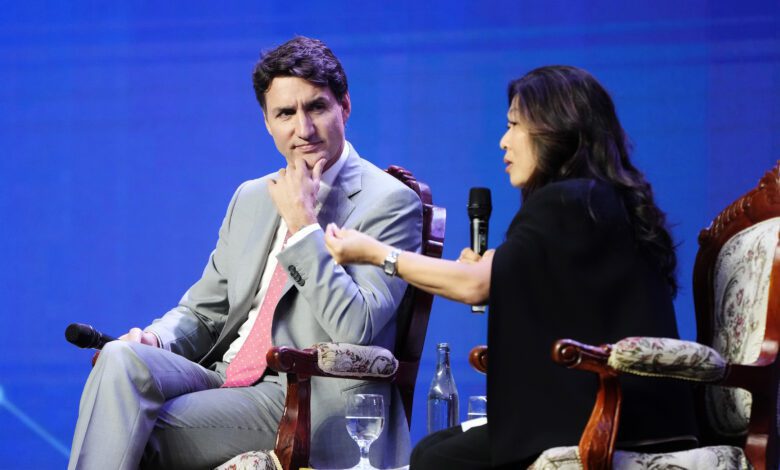
International Trade Minister Mary Ng said she was “disappointed” by reports in October 2024 that Liberal MPs were organizing an effort to persuade Prime Minister Justin Trudeau to resign. Speaking during a refuelling stop in Honolulu after an ASEAN summit in Laos, Ng said she retained full confidence in Trudeau’s leadership.
What was being organized
Members of the Liberal caucus had been approaching colleagues to sign a private document calling for a change at the top. Sources said copies and photographs were restricted, making the precise number of supporters difficult to verify at first.
The effort was significant because it came from government MPs rather than opposition parties. It was not, however, a formal leadership review or a parliamentary confidence vote, and no cabinet ministers were publicly associated with the document.
Ng’s defence of the prime minister
Ng said Canadians expected Liberal MPs to focus on their needs and described disagreement within caucus as part of healthy, robust discussion. Asked directly whether Trudeau still had enough support to continue, she answered yes.
Her statement represented the cabinet position, not proof that the caucus was unified. In a Westminster system, ministers ordinarily support the government publicly or leave cabinet, while backbench MPs have more room to express dissent.
Why pressure was growing
The Liberals had lost Toronto—St. Paul’s and LaSalle—Émard—Verdun, two seats long considered safe, in federal byelections. The New Democratic Party had ended the supply-and-confidence agreement that helped the minority government survive, and campaign director Jeremy Broadhurst had resigned.
Polling showed the Conservatives with a substantial lead. Dissident MPs worried that Trudeau’s personal standing and the government’s record on affordability, housing and the carbon price would put their seats at risk.
The immediate revolt did not remove him
At an October 23 caucus meeting, MPs presented their concerns and some asked Trudeau to decide by October 28 whether he would leave. He said the following day that he intended to remain leader.
The caucus had no simple automatic mechanism to remove him. The Reform Act permits parties to adopt rules for caucus-triggered leadership review, but Liberal MPs had not put such a binding process in place for that Parliament.
Later events changed the answer
Trudeau’s position weakened further after Finance Minister Chrystia Freeland resigned from cabinet in December 2024. On January 6, 2025, he announced that he would resign as party leader and prime minister once the Liberals selected a successor.
Mark Carney won the leadership in March. The later resignation does not prove that every anonymous report in October was accurate, but it shows that the underlying concern about Trudeau’s ability to continue had not disappeared.
How to evaluate anonymous caucus reporting
Political reporters sometimes rely on confidential sources because MPs fear retaliation. Readers should nevertheless distinguish confirmed public statements, independently corroborated details and estimates of how many people signed a document.
Ng’s criticism and the dissenting MPs’ effort were both legitimate political acts. One emphasized cabinet unity and governing responsibility; the other argued that leadership had become an electoral liability. A balanced account does not treat loyalty as proof of success or dissent as proof of a completed coup.
The episode ultimately marked a stage in a longer transition. In October 2024 Trudeau survived the challenge, but the party’s leadership question remained unresolved until events forced a formal succession process months later.



