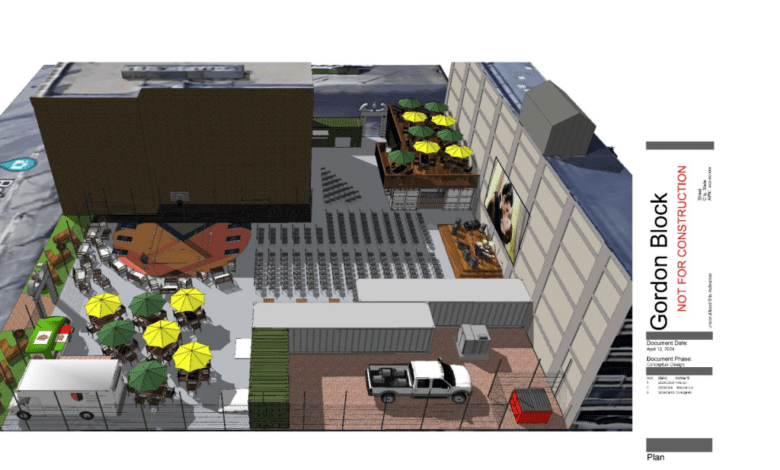
Regina Downtown Business Improvement District announced in October 2024 that an interim public venue called “The Skuare” was planned for 2160 12th Avenue. The 11,000-square-foot project would reuse the former Gordon Block and Burns Hanley sites for food, retail, events and public art, with an opening targeted for summer 2025.
A temporary use for vacant land
The project was described as interim, meaning the site could become active before a permanent redevelopment was ready. Temporary spaces can reduce the visual and economic gap created when a building disappears and a parcel remains fenced or empty.
That status also requires honest expectations. Businesses and community groups need to know the likely operating term before investing in equipment or treating the site as lasting infrastructure.
What organizers proposed
Plans included a beer garden, small retail and food-and-beverage units, room for food trucks, a performance and activation area, washrooms and storage for Regina Downtown’s Clean Team. Shipping containers were to house some uses.
A large wall could support films and video, while the central area could host live music, markets, weddings and private functions. The mix aimed to create reasons to visit outside a conventional office-day schedule.
The significance of the location
The Gordon Block and Burns Hanley sites carried downtown history. Organizers proposed a mural honouring that heritage and planned an open call for artists, with opportunities for additional large-scale work.
Public art should do more than decorate a commercial venue. A transparent artist selection, fair payment and consultation with people connected to the site can make the historical interpretation credible.
Who was paying
Funding was expected from the City of Regina, Harvard Developments and the downtown business district. Further sponsorship and partnership opportunities were to be announced in January 2025.
The initial announcement did not provide a full capital and operating budget. Before judging value, residents would need to know construction cost, sponsorship terms, lease arrangements, projected revenue and responsibility for maintenance and security.
Opportunity for small vendors
Food trucks and container-based retail can let entrepreneurs test a downtown market without taking a full storefront. Short licences, shared seating and common utilities may lower entry costs.
Vendor selection should be open, and fees should not quietly exclude small or culturally diverse operators. Reliable power, water, waste removal and delivery access determine whether an attractive rendering can function as a workplace.
A public space with licensed uses
A beer garden and private events can generate revenue, but they can also make a nominally public place feel closed. Organizers should publish hours when anyone may enter without buying a product and identify when the site is reserved.
Accessibility needs to cover level routes, washrooms, seating, signs and performance viewing. Shade, wind protection and transit connections are especially important on an exposed Prairie site.
Safety without exclusion
Activation can increase informal supervision and foot traffic. It should not become a rationale for displacing unhoused residents or applying rules selectively to people who cannot spend money.
Clear conduct standards, trained staff and links to outreach services are more durable than design intended solely to prevent resting or gathering.
How Regina could judge the experiment
Useful measures include daily visits, event attendance, vendor sales, repeat participation, incidents, accessibility feedback and the share of hours available free to the public. Neighbouring businesses and residents should be surveyed before and after opening.
The Skuare’s deliberately unconventional name and container design could attract attention, but novelty was not the real test. Success would mean a previously inactive parcel supported local livelihoods, culture and everyday downtown life while Regina planned its permanent future.