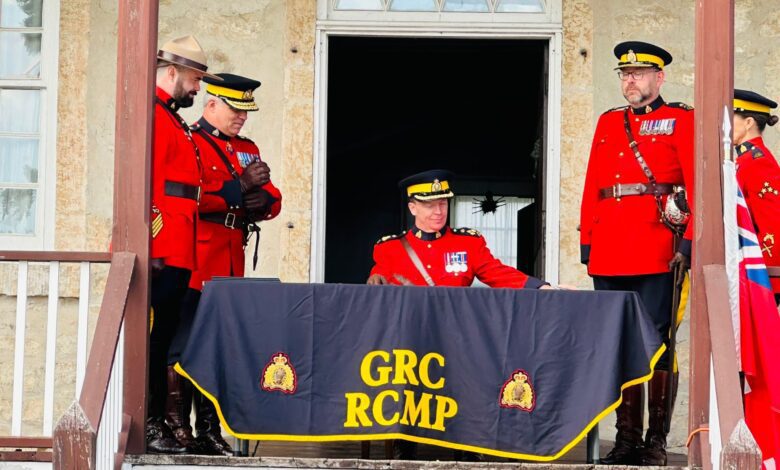
Assistant Commissioner Scott McMurchy was formally welcomed as commanding officer of the Manitoba RCMP during a change-of-command ceremony at Lower Fort Garry in October 2024. The event marked his assumption of leadership of D Division, the RCMP organization responsible for provincial policing in Manitoba.
A ceremonial transfer of responsibility
McMurchy signed command parchments and accepted the divisional ensign from Deputy Commissioner Rob Hill. Senior officers, employees, dignitaries, relatives and community representatives attended the ceremony at the national historic site north of Winnipeg.
The formalities are more than decoration. The ensign and signed record identify who is accountable for operational leadership, employee welfare and the relationship between the police service and the communities it serves.
Deep Manitoba roots
McMurchy was born in Rossburn and raised in The Pas, which he continued to describe as home. By the time of the ceremony, he had served with the RCMP for 34 years.
His career began in Saskatchewan before assignments brought him back to Manitoba. He worked in communities including Gillam and Thompson and later served in supervisory and operational roles in northern Manitoba and Winnipeg.
Experience across the division
The RCMP’s official profile described work in community and Indigenous policing, criminal investigations, serious and organized crime, provincial support services and northern operations. That range matters in a province where the same police division serves remote communities, highways and growing urban areas.
A commanding officer does not direct every investigation personally. The role sets priorities, allocates resources, supports detachment leaders and represents the division with governments, Indigenous leadership and other police services.
Violent crime and drugs
McMurchy identified violent crime and the illegal drug trade as priorities. These problems are connected but not interchangeable: organized trafficking can drive weapons and exploitation, while family violence, mental-health crises and local conflicts require different prevention and response.
He emphasized intelligence-led work and integrated teams. Cooperation can help a small detachment reach specialized investigators, but information sharing must still follow privacy law, evidentiary standards and clear lines of accountability.
Community-based policing
The new commander said police needed to involve residents in developing solutions rather than arrive with a programme designed elsewhere. The approach is particularly important in northern and First Nations communities, where distance, language, infrastructure and past policing experiences shape trust.
Consultation should produce measurable changes such as stable staffing, quicker responses, victim support and consistent follow-up. Meetings alone are not proof that a relationship has improved.
Reconciliation as operational work
McMurchy committed to listening and collaborating with First Nations, Métis and Inuit partners. Reconciliation in policing includes respectful investigations, cultural safety, recruitment, transparent complaint handling and implementation of relevant inquiry recommendations.
It also requires recognizing that Indigenous communities are distinct rights holders rather than a single stakeholder group. Local leadership and residents should be able to evaluate whether promised changes are reaching their detachments.
Supporting RCMP employees
A division leader is also responsible for members and civilian staff who face trauma, heavy workloads and difficult postings. Recruitment and retention problems can directly affect public safety when vacancies lead to burnout or long waits for service.
Effective leadership therefore includes mental-health support, sound supervision, training and an organizational culture in which misconduct can be reported without retaliation.
How the mandate should be judged
The ceremony gave Manitoba a visible moment of transition, but performance would be measured after it: trends in serious crime, case quality, response times, public complaints, workforce stability and trust across diverse communities.
McMurchy’s Manitoba background and operational experience offered useful context, not an automatic guarantee. His central task was to convert relationships and stated priorities into transparent, lawful policing that people could experience in daily life.