
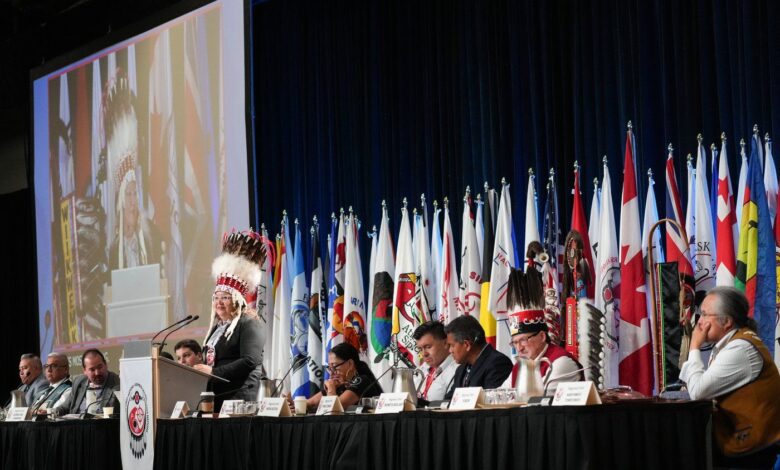
A mother whose family had struggled to obtain disability-related care under Jordan’s Principle appealed to First Nations chiefs in Calgary in October 2024 to support a proposed $47.8-billion child-welfare reform agreement with Canada. Carolyn Buffalo spoke as a representative plaintiff while chiefs debated whether the deal was strong enough to end discriminatory underfunding.
A family behind the legal language
Buffalo is from Montana First Nation in Maskwacis, Alberta. Her son Noah has cerebral palsy and requires continuing care, yet she said federal systems made essential support difficult to obtain while he lived on reserve.
Her intervention focused attention on children whose needs continue while governments and organizations negotiate. She did not claim that the agreement was perfect; she argued that rejecting it carried its own risk for families waiting for protection.
What Jordan’s Principle means
Jordan’s Principle is named for Jordan River Anderson, a First Nations child who remained in hospital while governments disputed which one should pay for home-based care. It requires the government first contacted to fund a needed public service without delay and resolve jurisdictional responsibility afterward.
The principle is meant to prevent First Nations children from receiving delayed, denied or disrupted services because of where they live or which government normally pays. Its implementation became a central part of the wider human-rights litigation.
The proposed settlement
The 10-year, $47.8-billion agreement was negotiated by Canada, the Assembly of First Nations, Chiefs of Ontario and Nishnawbe Aski Nation. It followed nearly two decades of proceedings over federal funding for First Nations child and family services on reserve.
In 2016, the Canadian Human Rights Tribunal found that Canada had discriminated against First Nations children through its funding and administration of those services. Long-term reform was separate from, although related to, compensation for people harmed by past discrimination.
Why some chiefs opposed it
Critics said the agreement lacked adequate consultation, regional control and safeguards to ensure discrimination would not return after the term ended. Some worried that approval could weaken existing tribunal orders before a replacement system had proved effective.
The Assembly of First Nations is a national advocacy forum, while individual First Nations are rights holders with different laws, service structures and local needs. That distinction made both consent and implementation unusually complex.
Buffalo’s warning
Speaking emotionally, Buffalo said she did not place unquestioning trust in either the federal government or the AFN. Her support came from the legal process and her belief that the proposed protections were better than leaving children in uncertainty.
Another representative plaintiff, Ashley Bach, reminded delegates that children who had experienced care were following the debate. Their testimony did not eliminate the chiefs’ concerns, but it made the human cost of delay impossible to treat as an abstract negotiating tactic.
Chiefs rejected the agreement
Later on October 17, 267 of 414 chiefs and proxies voted against the resolution endorsing the deal. The result was a clear rejection of that proposed agreement, not a rejection of reform or of the tribunal’s finding of discrimination.
The assembly subsequently supported a new negotiating process with First Nations-led regional participation, technical support and oversight. That path aimed to answer the consultation concerns while preserving pressure for stable funding.
The standard for the next agreement
A replacement needed enforceable funding rules, transparent outcomes, independent monitoring and a way for children and families to obtain services quickly. It also needed the informed direction of First Nations rather than a model imposed by Ottawa or a national organization.
Buffalo’s appeal and the vote can both be reported fairly. Families urgently needed reliable care, and chiefs had a duty to test whether a multi-decade reform would actually end discrimination. The challenge after Calgary was to negotiate better without allowing another generation to wait for the services already promised in law.



