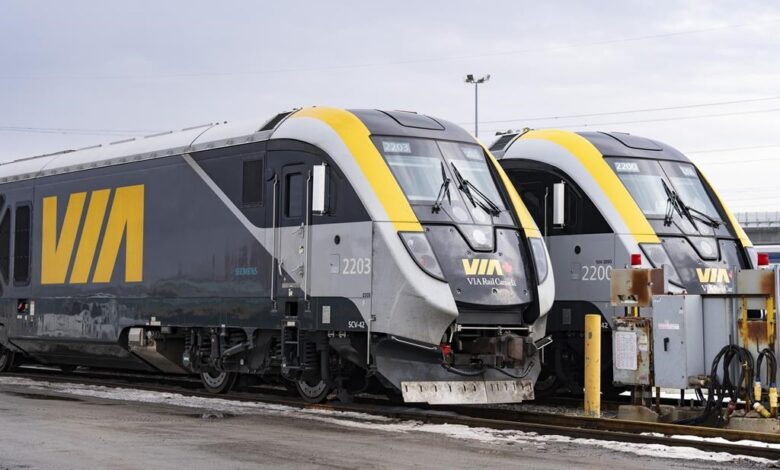
Passengers using VIA Rail’s busiest corridor were warned in October 2024 that trips could take longer after Canadian National Railway imposed a new speed restriction on VIA’s Siemens Venture trainsets at public level crossings. The rule affected services between Montreal and Windsor, Ontario, including the heavily travelled Toronto, Ottawa and Quebec City routes.
What CN changed
CN owns much of the track over which VIA operates in central Canada. It directed the new trains to reduce speed while approaching public crossings on its infrastructure, saying the Venture sets did not have the axle count specified for normal operation of some track circuits.
Railway crossing systems commonly detect a train through its interaction with an electrical circuit in the rails. CN said the configuration raised a concern about reliable activation of warning equipment. A restriction intended to manage that risk can be prudent even without an accident, but the technical basis and remedy still require clear evidence and coordination.
Why the trains were affected
VIA’s Venture consists had 24 axles, while CN’s operating requirement cited 32. VIA said simply attaching another passenger car was not a practical answer because the trainsets were designed as integrated units and adding equipment would affect operations, maintenance and accessibility.
The Crown corporation said it was examining devices known as shunt enhancers, which can improve the way a train is detected by a track circuit. Any technical modification would need testing and acceptance by the infrastructure owner before the restriction could be removed.
Longer trips for passengers
VIA estimated that the rule was adding roughly 30 minutes to an average affected journey. The precise delay varied by route and the number of crossings, so travellers were advised to check their own departure rather than assume every train would arrive half an hour late.
The impact was substantial because the Quebec City–Windsor corridor carried about 96 per cent of VIA’s passengers and generated more than four-fifths of its revenue. Even a modest restriction repeated across many crossings could compound existing congestion on freight-owned track.
The companies disagreed over notice
VIA said the October direction arrived without sufficient advance notice and emphasized that its Venture fleet had operated for about two years without a reported crossing incident. CN said it had raised axle-count concerns with VIA as early as 2021 and had already applied a related rule in March 2024 on routes where the new trains were running.
Those positions were not identical: absence of a collision does not by itself prove every detection system is reliable, while a prior technical warning does not establish that passengers and schedulers received adequate notice of an operational change. A transparent joint test programme would address both questions more effectively than public blame.
Other infrastructure owners
VIA said Canadian Pacific Kansas City and Ontario transit agency Metrolinx had not imposed the same restriction on their portions of the network. That comparison did not necessarily mean CN’s concern was unfounded, because track circuits, crossing equipment and operating standards can differ from one network to another.
It did show why national passenger service becomes vulnerable when different track owners apply different technical requirements. VIA cannot unilaterally set speeds on infrastructure it does not control.
A broader reliability problem
VIA’s on-time performance had already been weak: the corporation reported that only 59 per cent of trains were on time in 2023, after 57 per cent in 2022. Freight traffic, infrastructure constraints, mechanical problems and speed restrictions can all contribute, and the October change added another source of uncertainty.
All 32 new Venture trainsets were expected to enter service by the following summer. The immediate priority was therefore a verified crossing-safety solution that did not normalize permanent delays. Passengers needed accurate schedules and advance alerts, while CN and VIA needed to publish enough technical explanation to demonstrate that safety and reliable public service were being addressed together.