
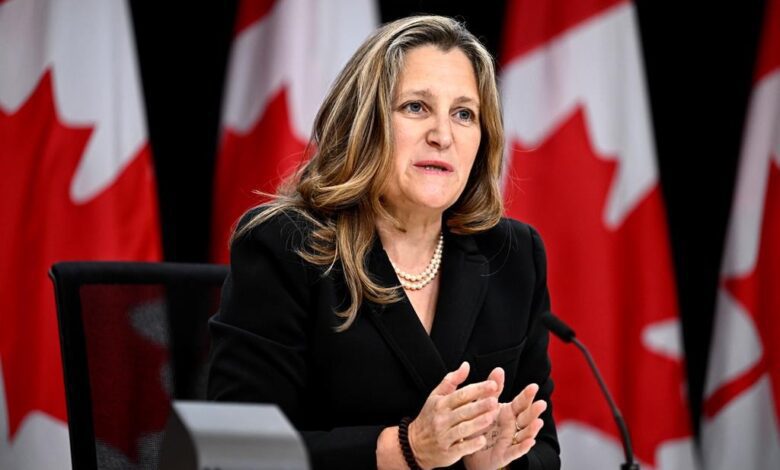
Deputy prime minister Chrystia Freeland said on October 18, 2024 that she was “absolutely confident” a vast majority of Liberal MPs supported Prime Minister Justin Trudeau. Her statement came days before a caucus meeting at which dissident MPs planned to argue that Trudeau should leave the party leadership.
A public show of support
Speaking in Winnipeg, Freeland said caucuses naturally contained a range of views but gave Trudeau her full support as leader of both government and party. Foreign Affairs Minister Mélanie Joly also publicly backed him and encouraged MPs to raise concerns directly in caucus.
Cabinet solidarity made those statements politically important. Ministers normally defend the government collectively or leave cabinet if they can no longer do so.
The scale of dissent was unclear
Media organizations reported that a group of Liberal MPs had circulated a document asking Trudeau to resign after more than a year of poor polls and losses in previously safe Toronto and Montreal byelections.
Organizers kept the text and names private, so neither the government nor reporters could independently count all supporters at the time Freeland spoke. “Vast majority” was therefore her assessment, not the result of a published caucus ballot.
Why caucus could not simply remove him
The Liberal caucus did not have an adopted process providing a binding leadership-review vote under the Reform Act. MPs could create political pressure, but Trudeau retained the formal choice to continue.
That distinction matters: public support from ministers could stabilize him, while private dissent could still damage fundraising, nominations and the willingness of incumbents to run again.
The October confrontation
At the October 23 caucus meeting, 24 MPs submitted a letter urging Trudeau to step down and gave him several days to decide. He rejected the effort and said he intended to lead the party into the next election.
Freeland’s statement was compatible with a majority still supporting him at that moment, because 24 MPs did not represent most of the caucus. It did not show how many others were undecided, privately dissatisfied or supportive only because no transition plan existed.
What changed by December
On December 16, Freeland resigned from cabinet hours before she was due to deliver an economic statement. Her letter described disagreement with Trudeau over fiscal policy and the response to threatened U.S. tariffs.
That dramatic break weakened Trudeau and showed why a loyalty statement must be dated. It would be misleading to quote the October assurance as if it described Freeland’s position two months later.
The eventual transition
Regional caucuses and more individual MPs called for Trudeau to leave after Freeland’s resignation. In January 2025, he announced he would step down once Liberals selected a successor.
Mark Carney won the March leadership contest. The transition confirmed that internal opinion evolved, not that Freeland necessarily misstated what she believed in October.
How to read leadership claims
Words such as “majority,” “significant” and “united” can conceal different levels of enthusiasm. The strongest evidence is a recorded vote or a public list, neither of which existed for the October dispute.
Freeland’s defence accurately represented her declared position on October 18. A complete account also records the organized dissent, the absence of a binding removal mechanism and the later rupture. Together, those facts show a government that still projected unity while its internal support was becoming increasingly fragile.



