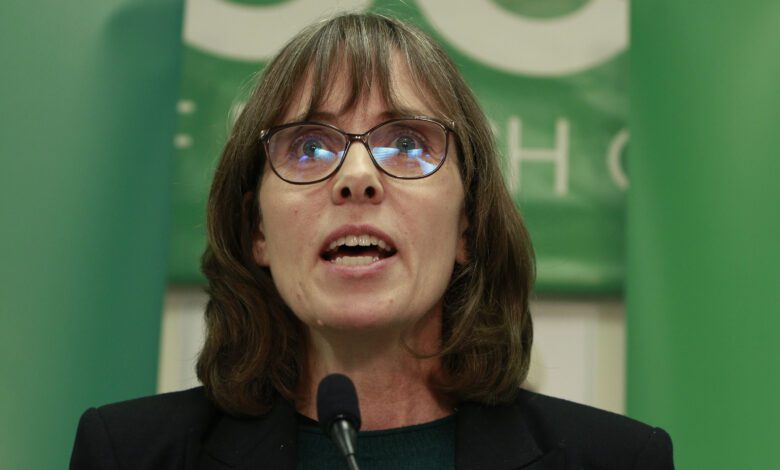
BC Green Party leader Sonia Furstenau lost Victoria-Beacon Hill in the October 2024 provincial election, even as two Green candidates won elsewhere. The mixed result removed the party’s leader from the legislature while preserving a two-seat caucus that could matter in a closely divided chamber.
Furstenau’s new riding
Furstenau had represented Cowichan Valley for seven years but chose to run in Victoria-Beacon Hill after electoral-boundary changes. NDP incumbent Grace Lore won the district, defeating Furstenau by a substantial margin.
Moving ridings can require a leader to build recognition and organization among new voters. Lore also entered the contest as a sitting MLA and cabinet minister, giving the NDP an established local base.
Two Green victories
Rob Botterell won Saanich North and the Islands, succeeding retiring Green MLA Adam Olsen. Jeremy Valeriote won West Vancouver-Sea to Sky after having lost the same area by only 60 votes in 2020.
Elections BC’s final count confirmed two Green seats, compared with 47 for the NDP and 44 for the Conservatives. Those official figures replaced election-night projections and showed that the NDP had reached the 47-seat majority threshold on its own.
Why the leader’s defeat still mattered
A provincial party leader does not have to hold a seat, but an unelected leader cannot speak or vote in the legislature. The caucus therefore had to decide how its two newly elected MLAs would divide parliamentary work while the party considered its longer-term leadership arrangements.
Both Green MLAs were newcomers, increasing the transition challenge. Legislative rules, committee duties, constituency service and negotiations all begin immediately even when a party is reorganizing.
Balance of power or strategic influence?
On election night, uncertain close races raised the possibility that the Greens would hold the balance of power. Once final counting gave the NDP 47 seats, the government did not formally need Green support to reach a majority of all seats.
That did not make the Greens irrelevant. A one-seat margin can be affected by the election of a Speaker, absences or dissent, and Green votes could still influence committees, amendments and public debate. “Balance of power” should nevertheless be used carefully after the final result.
A smaller share of the vote
The Greens’ province-wide vote share declined from 2020, partly because they fielded fewer candidates and the contest became polarized between the NDP and Conservatives. Concentrated support allowed the party to win two districts despite that broader decline.
The pattern illustrates why seat totals and popular vote answer different questions. Local plurality winners determine seats, while province-wide vote share indicates overall support but does not translate proportionally under the electoral system.
Policy continuity
The Green caucus continued to emphasize climate action, ecological protection, health care, housing and limits on fossil-fuel expansion. With only two members, it needed to choose issues where detailed proposals or negotiated amendments could have visible impact.
The NDP could not assume Green support merely because both parties occupied space to the left of the Conservatives. The previous confidence-and-supply agreement after the 2017 election showed cooperation was possible, but 2024 produced different arithmetic.
The accurate takeaway
Furstenau’s personal defeat was a serious setback, not the disappearance of the BC Greens. Botterell and Valeriote secured representation and official final results left the party with a small but potentially consequential caucus.
The election gave the Greens two simultaneous tasks: represent the districts they won and rebuild leadership after losing their best-known legislator. Their influence would depend less on a dramatic label and more on the quality of their legislative work in an unusually tight assembly.