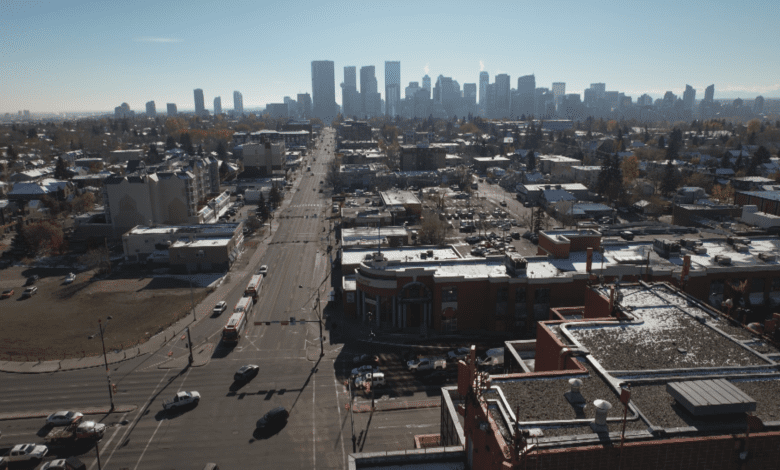
Transit and business advocates asked Calgary to introduce rush-hour bus lanes and end reversible traffic lanes on Centre Street in October 2024. They argued that the city’s busiest transit corridor needed immediate improvements while the northern extension of the Green Line LRT remained uncertain.
The proposed Centre Street changes
LRT on the Green and the Crescent Heights Village Business Improvement Area sent the city a plan covering Centre Street from Fourth Avenue South to 20th Avenue North. It called for northbound and southbound curb lanes to operate as bus-only lanes during rush hour.
The proposal also sought permanent removal of the rush-hour lane reversal, public-realm upgrades and new traffic signals roughly every two blocks to improve pedestrian crossings.
Why advocates called the corridor broken
Jeff Binks of LRT on the Green said tens of thousands of daily bus passengers were delayed in the same congestion as private vehicles. The city described Centre Street as its busiest transit corridor, with more than 1,000 bus movements a day.
A dedicated lane can move more people when buses are frequent and well used, even if the number of general-traffic lanes falls. The result depends on enforcement, signal priority, stop design and whether displaced traffic overwhelms nearby streets.
The Green Line connection
A later phase of the planned LRT was intended to cross the Bow River and continue north along Centre Street. In 2024, however, the project’s route and funding were in dispute while Alberta sought a new alignment for the southeast and downtown portion.
Advocates said the city should improve bus service rather than wait for an uncertain rail extension. A bus-lane investment can provide near-term benefit and test transit demand, but it should not be represented as identical to rail capacity.
Business and pedestrian concerns
Crescent Heights BIA executive director Camie Leard said anticipated LRT construction had discouraged investment and left sidewalks in poor condition. More crossings and public-realm work could make the street easier to visit rather than treating it solely as a route through the neighbourhood.
Businesses can benefit from walking and transit access, while loading, deliveries and accessible parking still require planning. Curb management is therefore part of a workable bus-lane design.
The city’s existing work
Calgary said new bus stations were being installed during 2024 and 2025 to support a future MAX route and possible dedicated lanes. Council had approved an additional $60 million for north-Calgary bus rapid transit in 2023.
Binks argued that investment north of 16th Avenue would lose value if buses remained trapped in congestion south of it. Corridor planning needed to measure the complete trip rather than only a faster segment.
Concerns about displaced traffic
Ward 7 councillor Terry Wong supported studying the idea but warned that removing a downtown-bound lane could create long queues. He called for consultation before a commitment.
That concern can be tested with traffic counts, bus travel times, person-throughput and a temporary pilot. A study should measure safety and reliability, not simply whether car speeds fall.
A decision based on movement, not lanes
Centre Street’s purpose is to move people and support a neighbourhood. Measuring only vehicles can undervalue a full bus, while ignoring deliveries or emergency access can undermine local confidence.
A reversible, monitored pilot with clear success criteria could reveal the actual trade-offs. The advocates’ proposal offered Calgary a way to act during the Green Line delay, but implementation required design, enforcement and transparent before-and-after evidence.