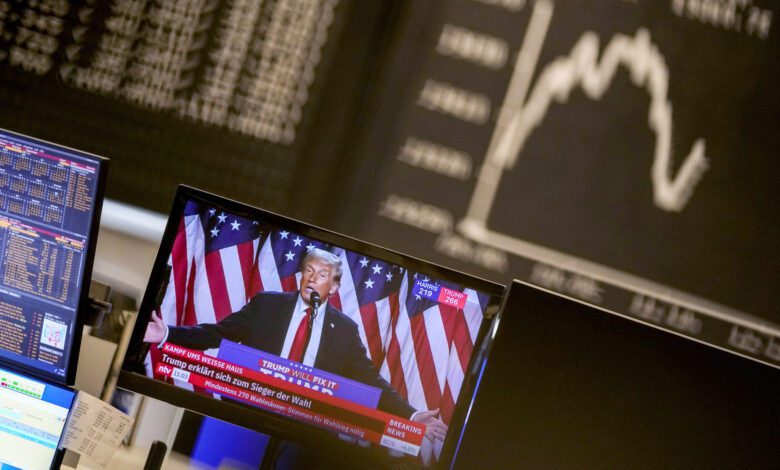
U.S. stocks rose sharply after Donald Trump’s 2024 election victory, but investment professionals warned that the immediate “Trump bump” did not establish a lasting market direction. A decisive result reduced one source of uncertainty, while expectations of deregulation and tax policy lifted sectors investors thought might benefit.
The first-day market moves
The Dow Jones industrial average gained slightly more than 1,500 points on November 6. The S&P 500 rose 2.5 per cent, while Canada’s S&P/TSX composite added 228 points to close at 24,608.41. Large U.S. banks including Goldman Sachs and JPMorgan Chase helped lead the advance.
Government bond yields also climbed. The U.S. 10-year Treasury yield increased by more than 15 basis points, with long-term Canadian yields moving upward as well. Rising stocks and rising yields can coexist when investors expect stronger growth, more borrowing or higher inflation.
Why certainty mattered
Allan Small of iA Private Wealth said investors had prepared for the possibility that vote counting and disputes would leave the outcome unclear for days. A known winner removed that short-term risk. Expectations that a Republican administration would reduce regulation also supported banks and other selected industries.
Markets price anticipated future profits, rates and risks rather than reward a politician in a simple partisan vote. The initial move reflected collective expectations that could change as appointments, legislation and economic data emerged.
Reasons the rally might fade
Josh Sheluk of Verecan Capital Management described the response as reactionary and potentially short-lived. Campaign proposals can be altered, delayed or blocked, and different policies can pull markets in opposite directions.
Tax reductions and deregulation may support profits, while tariffs and labour constraints may raise costs and inflation. Larger deficits can increase bond yields, which can make borrowing more expensive and reduce the present value investors assign to future earnings.
Why chasing the move carries risk
Assets such as bitcoin also rose and prompted calls from investors seeking immediate exposure. Buying after a rapid increase can mean paying a price that already assumes favourable outcomes. Selling a diversified portfolio because of a feared political result can similarly lock in losses or miss a reversal.
Sheluk recommended little or no direct change for an average investor based solely on the election. Small suggested waiting at least a day, and sometimes three, before reacting. Neither comment guaranteed that markets would remain high or fall; the advice addressed the difficulty of short-term prediction.
A more durable investment test
Investment decisions should begin with goals, time horizon, fees, taxes, diversification and tolerance for loss. A globally diversified portfolio already contains companies affected differently by U.S. policy. Rebalancing to a planned allocation is different from placing a concentrated bet on one election narrative.
People needing money soon have different risk capacity from long-term retirement investors. Anyone considering leverage, options or cryptocurrency should understand that losses can be rapid and that general market commentary is not individualized financial advice.
The November rally was real, and its causes were plausible. Its durability could not be known on the day. The useful lesson was not to ignore politics, but to separate a one-session price move from evidence about long-term earnings and economic policy. Markets would continue to reassess the administration; investors needed a plan designed to survive that uncertainty rather than a portfolio built around the first reaction.