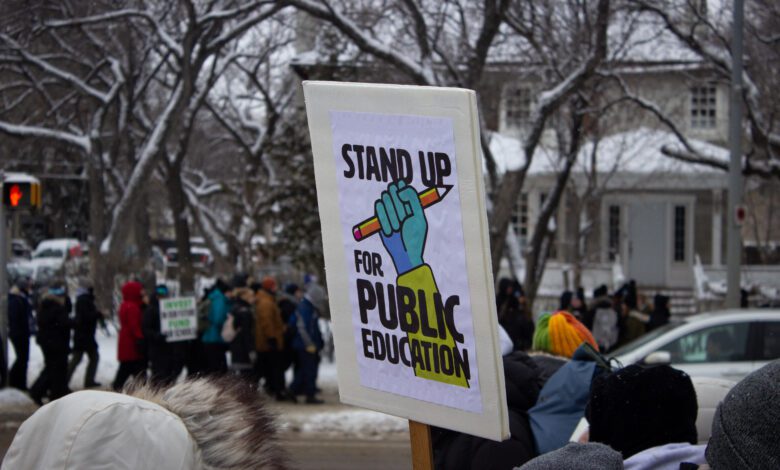
Education was a major issue before Saskatchewan’s October 28, 2024 election after a year of teacher job action and prolonged bargaining. Classroom size and complexity, staff burnout, violence, specialist support and school infrastructure shaped the choice between the governing Saskatchewan Party and the opposition New Democrats.
Classroom size and complexity
Teachers argued that the challenge was not simply the number of desks. A class may include students learning English, students with disabilities, different grade levels and children needing behavioural or mental-health support, all with limited specialist help.
Large or complex classes can reduce individual attention and increase preparation. Reliable public reporting should measure enrolment, teacher and educational-assistant staffing, specialist wait times and needs—not rely on a single province-wide ratio.
Safety in schools
Veteran educator Sue Amundrud said reports of violence toward staff had become more common and that access to social workers, psychologists and mental-health professionals could take far too long. Police presence could address an immediate threat but was not a complete solution.
Prevention includes trained support staff, early intervention, appropriate classroom placement, safe building design and consistent incident reporting. Students with complex needs require support rather than stigmatization, while workers and classmates deserve protection.
The bargaining dispute
The Saskatchewan Teachers’ Federation and provincial government had spent months without a new collective agreement. Teachers held rotating strikes and withdrew some voluntary services while pressing for enforceable action on class size and complexity.
A tentative agreement was rejected by members before the parties moved toward binding arbitration on the central issues. Labour disruption affected families, but it emerged from a dispute about who would control and fund classroom conditions.
Saskatchewan Party commitments
Scott Moe pointed to a provincial budget with roughly $2.2 billion in school operating funding, $356 million associated with classroom size and complexity, and $156 million for infrastructure. Voters needed to ask which amounts were new, multi-year or already committed.
Spending announcements become meaningful when translated into staff hired, spaces built, wait times reduced and support reaching classrooms. Inflation and enrolment growth can absorb an increase before services improve.
NDP commitments
Carla Beck’s NDP promised an additional $2 billion for education over four years, describing annual cumulative operating increases and support for infrastructure and students with learning needs.
The party needed to identify revenue sources, hiring timelines and how rural and northern divisions would recruit specialized workers. A large total does not guarantee personnel are available or money is allocated effectively.
Student learning outside school
A Regina tutoring provider reported that more students arrived needing help in several subjects as well as organization and time management. Private tutoring can assist families who can pay but should not become the workaround for inadequate public support.
Achievement data should be interpreted alongside attendance, disability, language, poverty and disruption. Test scores alone cannot diagnose the cause of a learner’s difficulty.
Questions voters could apply
Useful comparisons included per-student operating funding after inflation, class-size distribution, educational assistants, counsellor ratios, capital repair backlogs and transparent reporting of violent incidents. Parties also needed plans for teacher retention outside major cities.
The Saskatchewan Party ultimately won another majority, but the election did not end the education challenge. Durable progress required a funded agreement, measurable classroom improvements and regular public data showing whether students and staff were actually safer and better supported.