
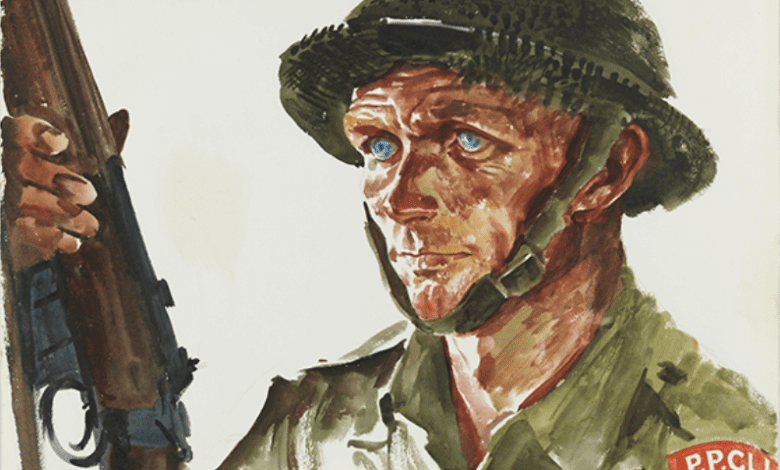
Two exhibitions at the University of Calgary’s Founders’ Gallery inside The Military Museums used art to examine Canadian military experience in November 2024. One centred on paintings by war artist Bill MacDonnell; the other, “Far From Home,” marked 110 years of Princess Patricia’s Canadian Light Infantry. Together they presented remembrance as an encounter with lived consequences rather than a display of weapons alone.
Bill MacDonnell’s witness to conflict
Curator and war artist Dick Averns selected MacDonnell’s work addressing conflict from Bosnia to Afghanistan. The paintings did not claim to substitute for a complete operational history. They conveyed places, damage and emotional impressions that can disappear from official chronology.
Averns described a risk of “cultural amnesia”: the tendency to forget the scars of conflict when witnesses and visual records fade. He said MacDonnell’s example influenced his own path as a war artist. That relationship shows how artistic memory passes between practitioners as well as between veterans and the public.
“Far From Home” and a regiment’s history
Retired lieutenant-colonel Bill Bewick curated the second exhibition for the 110th anniversary of Princess Patricia’s Canadian Light Infantry. Founded in 1914, the regiment’s history spans the world wars and later operations. The exhibition connected earlier service with the experiences of people who continued to serve in more recent decades.
Bewick had accompanied MacDonnell to the former Yugoslavia in the 1990s and also displayed work in the gallery. He emphasized that war artists had directly seen, heard and experienced the environments they represented. Proximity gives their work force, although viewers should still distinguish personal interpretation from documentary evidence.
What art can contribute to military history
A photograph or painting can preserve texture, posture and absence in ways an after-action report cannot. It can make civilians pause over consequences that numbers compress. Art can also challenge official narratives by selecting the ruined building, exhausted face or uncertain landscape rather than the ceremonial moment.
It remains a constructed view. The artist chooses where to stand, what to omit and how to arrange colour and scale. Galleries should provide dates, locations, commissioning context and testimony so visitors can understand both the subject and the choices behind the image.
Remembrance without romanticizing war
Honouring service does not require presenting conflict as clean or glorious. An exhibition can recognize courage and sacrifice while showing displacement, trauma and moral ambiguity. That balance is especially important for students who may encounter military history first through dramatic images.
Veterans may respond differently to the same work. For some, it validates experience; for others, it can reopen difficult memories. Museums should provide thoughtful interpretation, accessible spaces and information about support resources when exhibits contain distressing material.
A “hidden gem” inside the museum
Averns called the Founders’ Gallery easy to overlook. The two exhibitions were scheduled through February 17, 2025, giving visitors several months beyond Remembrance Day to engage with them. The date also underscored that remembrance should not be confined to one annual ceremony.
MacDonnell’s paintings and “Far From Home” approached military history through individual perception. Their lasting contribution was not to make viewers feel one approved emotion, but to invite sustained attention to what war does and to the people who carry its record home.



