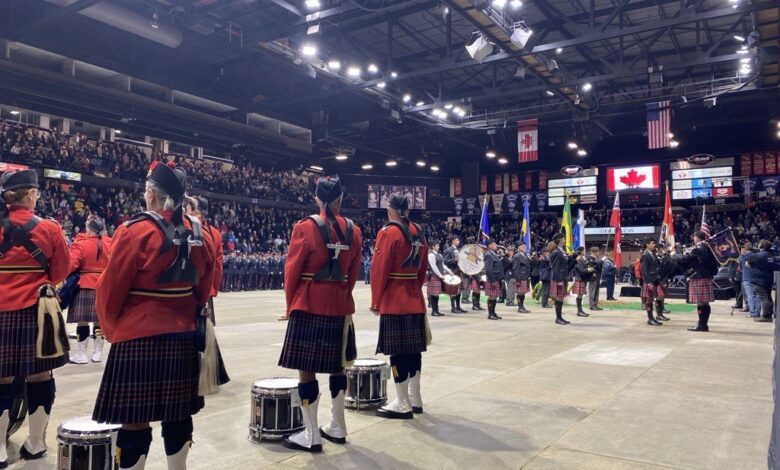
Thousands of people attended Remembrance Day observances in Regina on November 11, 2024, including a large indoor ceremony at the Brandt Centre and a service at the Victoria Park cenotaph. Veterans and Royal Canadian Legion representatives emphasized that remembrance involves passing firsthand stories to younger generations as the world wars recede further from living memory.
Two settings for a shared observance
The Brandt Centre accommodated a broad public gathering protected from Saskatchewan’s November weather, while the cenotaph provided the traditional civic setting for wreaths and silence. Multiple ceremonies allowed residents to participate in different ways without changing the central purpose of honouring those who served and died.
Herbert Bechdoldt, who said he had been connected with the Canadian Armed Forces since the age of 16 and participated in the colour party, encouraged people to attend services, speak in schools or remember veterans privately. His comments recognized that public ceremony is important but not the only legitimate form of remembrance.
The emotional burden on veterans
Royal Canadian Legion vice-president Reid Hill said November 11 can be an emotional “roller coaster” for veterans because it brings back people and events from their service. Ceremonies should therefore avoid treating veterans as props or assuming that every participant experiences the day as uncomplicated pride.
Organizers can provide quiet areas, accessible seating and information about support. Members of the public can express gratitude without pressing a veteran for painful detail or making assumptions about combat.
Why voices matter
Hill warned that stories risk being lost as veterans of the First and Second World Wars die. Paintings, medals and museum objects preserve evidence, but recorded voices can explain how a person understood events and what happened after returning home.
Oral history needs context. Memory changes over time, and one veteran cannot represent an entire unit or conflict. Archives can pair interviews with service records, photographs and contemporaneous documents while retaining the speaker’s personal interpretation.
Expanding the record
Canadian remembrance should include Indigenous service members, women, racialized troops, peacekeepers, LGBTQ+ veterans, merchant mariners and military families whose experiences were often absent from older commemorations. Inclusion does not subtract from earlier stories; it makes the national record more complete.
It should also acknowledge the harm of war. Respect for service is compatible with scrutiny of political decisions, civilian suffering and failures to support veterans after deployment.
From ceremony to responsibility
A crowd of thousands demonstrates public attention for one morning. Lasting remembrance is shown through preservation of records, care for injured and aging veterans, support for families and education grounded in evidence. Governments and organizations should report whether services are timely and accessible rather than relying on ceremonial language alone.
The Regina gatherings brought residents together across generations and gave veterans a visible place in civic life. Their deepest message was not that everyone must remember in precisely the same way. It was that freedom, loss and military service have human histories that disappear if communities do not ask, listen and preserve them.
That work remains necessary between annual ceremonies.