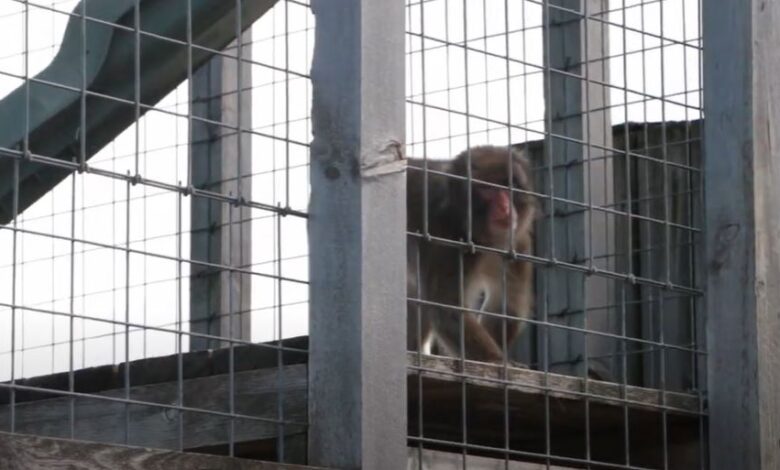
Animal-welfare advocates called on Ontario authorities in September 2024 to remove a Japanese macaque named Boogie from Bervie Zoological Park near Kincardine. Animal Justice said videos showed repetitive movements and self-directed biting that specialists associate with severe distress in captive primates.
The campaign relied on observed behaviour
Footage collected between 2022 and 2024 showed Boogie pacing, spinning, rocking and apparently biting himself, according to the organization. Such repetitive actions are often called stereotypic behaviour and can indicate an inadequate environment, isolation, frustration or chronic stress.
A video can raise an urgent concern, but a full welfare assessment also examines health, enclosure, social grouping and veterinary records.
Advocates proposed a specific destination
Animal Justice asked Provincial Animal Welfare Services to seize the macaque and transfer him to Story Book Farm Primate Sanctuary in Sunderland, Ontario. The sanctuary cares for primates retired from private ownership, research and entertainment settings.
A transfer would require authorities and qualified professionals to assess transport, quarantine and long-term placement.
Bervie had faced earlier intervention
Ontario officers removed dozens of animals from the roadside zoo in 2022. A baboon named Bruno was among those later placed at Story Book Farm, making the proposed sanctuary more than a hypothetical option.
Past enforcement provides context but does not automatically prove every new allegation.
Charges were still allegations at the time
In September 2024, the facility and people connected with it faced outstanding animal-welfare charges. Charges must be distinguished from convictions, and each allegation is subject to the legal process.
Reporting should also seek the operator’s response and any findings released by provincial inspectors.
Primates have complex needs
Japanese macaques normally live in social groups, travel through varied environments and spend substantial time foraging and interacting. A bare or socially unsuitable enclosure may fail to provide the stimulation, choice and relationships needed for psychological health.
Food and basic shelter alone are not a complete measure of welfare.
Ontario’s regulatory framework was contested
The province’s animal-welfare law established standards of care and enforcement powers, but advocates argued that Ontario lacked comprehensive zoo-specific licensing and inspection comparable with stronger regimes elsewhere.
Municipal exotic-animal bylaws also varied, leaving uneven oversight across communities.
Removal is not the only possible intervention
Depending on evidence, inspectors can order veterinary treatment, environmental changes or other corrective action, and can remove an animal in defined circumstances. The least disruptive option is not necessarily the safest if an animal remains in serious distress.
Independent primate expertise would help determine what Boogie required.
The case asked a wider public-policy question
Roadside zoos can operate far from the staffing, accreditation and enclosure resources of major institutions. Visitors may interpret visibility and feeding as evidence that an animal is thriving even when behaviour suggests otherwise.
The call to relocate Boogie was an advocacy position supported by troubling footage and the facility’s enforcement history. Provincial authorities, not campaigners or a news headline, held the legal power to investigate and decide. Transparent inspection findings would protect both due process and the animal whose condition prompted the complaint.