Video of Cattle Trader From Bengal Saying He Hasn't Been Able to Sell Cows Is AI

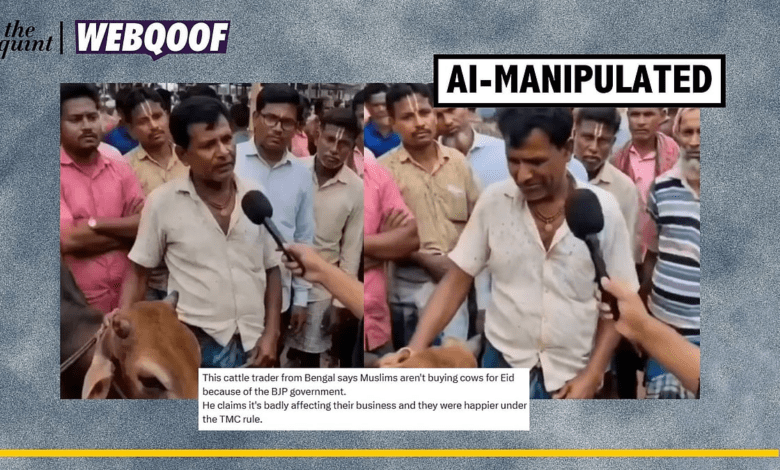
A viral video purporting to show a West Bengal cattle trader saying Muslims had stopped buying cows under the BJP government was generated with artificial-intelligence tools. Visual anomalies and an embedded provenance check supported that conclusion; the clip should not be used as testimony from a real trader.
What the post claimed
The caption said the speaker’s business had suffered because Muslim customers were afraid to buy cattle for Eid and that conditions had been better under the previous Trinamool Congress government. The message attached a synthetic interview to a current political and religious dispute, giving an invented person the appearance of firsthand authority.
Searches did locate genuine reporting about uncertainty among some cattle traders. That does not authenticate this particular video. A false witness can be wrapped around a real issue, and the existence of related concerns does not make fabricated evidence acceptable.
Visible signs of generation
Reviewers noted lip movements that did not consistently match the speech, hands that changed shape unnaturally and brief glitches in the image. Any one artifact might result from compression or editing. Several independent inconsistencies across a clip increase suspicion but still benefit from technical corroboration.
The video was then checked with Google’s Gemini system using SynthID, a watermarking and detection technology for media made with participating Google generative tools. The check indicated that the clip had been generated with Google AI. A platform-specific provenance signal is stronger than a generic detector score because it can identify a mark inserted during creation.
Limits of AI detection
SynthID does not identify who created the video, why it was posted or whether every frame was generated. Re-encoding and editing can affect provenance systems, while media created by other tools may have no compatible watermark. A “not detected” result therefore is not proof that a video is real.
Generic AI detectors can also produce false positives. Reliable verification combines provenance, visual inspection, source tracing and corroboration from the claimed place and person. Here, no credible original interview, named trader or established report contained the circulating footage.
Why the fabrication is harmful
The clip targeted a sensitive intersection of religion, livelihoods, animal law and a change of state government. Synthetic testimony can intensify communal suspicion and create apparent public support or anger that never existed. Reposting it with a correction buried later can still expose new viewers to the false claim.
The appropriate response is to preserve the URL and a copy for verification, avoid amplifying the deceptive caption, and link clearly to the debunk. Criticism of government cattle policy or its economic effects should be based on real traders, market data and official rules.
A practical check for interview clips
Look for the earliest upload, a named reporter, a recognizable outlet and a longer version showing continuous interaction. Slow the clip to inspect lips, teeth, fingers, reflections and background continuity. Search a quoted phrase and a reverse-searched frame. If a provenance tool is available, treat its result as one layer rather than the entire case.
The narrow verdict is conclusive: the viral “trader” clip is AI-generated. It neither proves nor disproves wider claims about Bengal’s cattle economy; those require separate, authentic evidence.
source