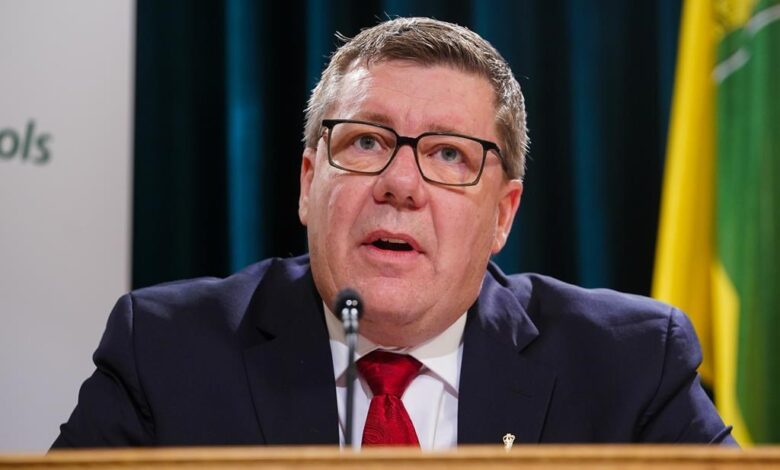
Scott Moe’s path to becoming Saskatchewan’s premier combined a rural upbringing, agricultural training and a competitive hockey background with an early political outlook that did not neatly match his later conservative leadership. His career also shows how biography can shape a public image without explaining every policy choice.
He grew up in agricultural Saskatchewan
Moe was born in Prince Albert in 1973 and raised on a grain farm near Shellbrook. He studied agriculture at the University of Saskatchewan, graduating with a Bachelor of Science in 1997, and later worked in farming and community business ventures.
That background became central to his political identity. Agriculture, resource development, transportation and the practical concerns of smaller communities have remained recurring themes in his public messaging.
Hockey helped build his competitive reputation
Moe played defence and was remembered for a powerful shot. The description of him as a “lights-out” shooter belongs to the personal stories surrounding his hockey years rather than an assessment of his record in government.
Sports narratives can make politicians seem familiar and relatable, particularly in a province where community hockey has deep cultural importance. They should not replace scrutiny of decisions made in office.
His early political sympathies reportedly leaned left
Accounts of Moe’s younger years have described an affinity for the New Democratic Party before he joined the Saskatchewan Party in 2003. Political views often change with experience, party coalitions and economic priorities, and his subsequent career was firmly on the centre-right.
He won election to the provincial legislature in 2011 for Rosthern-Shellbrook and served in cabinet, including as environment minister. In 2018, he won the Saskatchewan Party leadership and became premier.
Economic autonomy became a defining message
Moe positioned Saskatchewan as a defender of energy, mining and agriculture against federal policies he argued imposed unfair costs. His government strongly opposed the federal carbon-pricing system and pressed for greater provincial control over natural resources and regulation.
Supporters viewed that approach as protection for jobs and rural livelihoods. Critics said confrontation with Ottawa sometimes displaced cooperation on emissions reduction, public services and long-term economic transition.
Social policy intensified political divisions
His government introduced a law requiring parental consent when students under 16 wanted schools to use a different gender-related name or pronoun. The province invoked the notwithstanding clause to protect the measure from parts of a constitutional challenge.
Supporters framed the policy as parental involvement. Opponents, including advocates for transgender youth, warned that it could expose vulnerable students and override their rights. The dispute became a defining test of Moe’s willingness to use legislative power on cultural issues.
Health and education remained major vulnerabilities
Long waits, staffing pressure and access to care generated criticism, while teachers raised concerns about classroom complexity and resources. These issues affected both urban and rural residents and complicated the government’s emphasis on economic performance.
The COVID-19 pandemic also placed Moe’s leadership under sustained scrutiny. Supporters and critics differed over the timing of restrictions and their removal, illustrating the difficult balance between public health, individual freedom and economic activity.
The 2024 election delivered a narrower majority
The Saskatchewan Party won a fifth consecutive majority in the October 2024 election, taking 34 of 61 seats, while the NDP won 27. The governing party retained strong rural support but lost substantial ground in Regina and Saskatoon.
That result kept Moe in office while exposing a sharper urban-rural divide. His personal story—from farm, university and hockey to conservative premier—helps explain his political style, but the durability of his government depends on whether voters see improvements in affordability, health care, education and economic opportunity.