Viral Image of Frontline’s Cover Page Featuring ‘Vijay Wave’ Is Altered

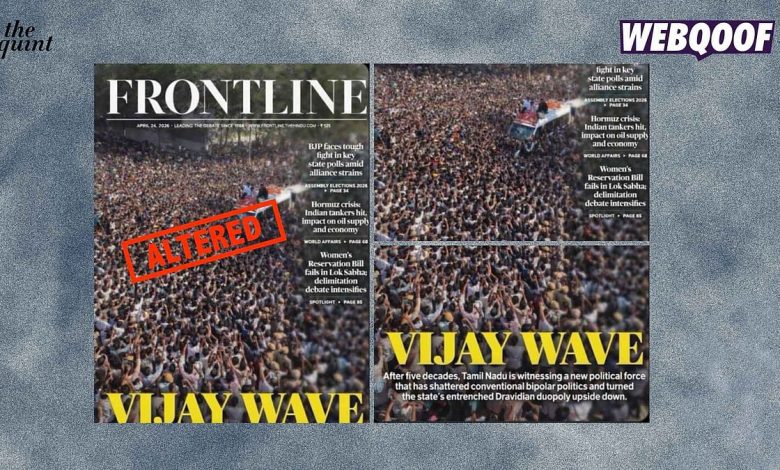
A viral image purporting to be a Frontline magazine cover declaring a “Vijay Wave” in Tamil Nadu was digitally altered. A reverse-image search traced the central rally photograph to a fan account, checks of recent Frontline issues found no matching cover, and the magazine’s official account said the image was fake.
What the fabricated cover implied
The image used the visual language of an established publication to suggest that Frontline had endorsed a sweeping political assessment of actor-turned-politician C. Joseph Vijay and his Tamilaga Vettri Kazhagam. A magazine cover carries more perceived editorial authority than an anonymous social-media poster, which is precisely why such templates are attractive to propagandists and fan communities.
The phrase “Vijay Wave” was not merely decorative. It presented a conclusion about statewide public opinion and electoral momentum. That kind of claim should be supported by actual reporting, polling or results, not a manipulated masthead.
How the alteration was established
Fact-checkers searched the image with Google Lens and did not find a corresponding Frontline issue. They located the same rally photograph in a post by an Instagram fan page from the previous week, indicating that the underlying event image existed separately from the supposed cover.
They also reviewed recent issues published by Frontline and found no edition with the circulating design. Most decisively, Frontline’s verified account issued a clarification that the cover was fake. Together, those steps addressed both the origin of the picture and the claimed publisher.
Why visual polish is not authentication
A copied logo, barcode, date line and typography can make an image look professional at phone-screen size. Compression hides mismatched fonts and rough edges. Generative tools can now reproduce a publication’s style even when the creator has limited editing skill.
Authenticity should be checked at the source. Search the publication’s website, digital edition or verified social accounts for the issue. Compare the date, volume number, cover lines and image with archived copies. If the cover appears only in partisan accounts and not in the publisher’s own catalogue, that absence is significant.
What the verdict does not prove
Showing that this cover was false does not determine Vijay’s actual political support. It neither proves that a “wave” existed nor proves that it did not. Electoral strength must be assessed through credible surveys, turnout, vote shares, organizational reach and completed election results.
Likewise, a rally photograph may be genuine while the publication frame around it is fabricated. Verification should identify the specific manipulated element instead of incorrectly labelling every component synthetic.
How to share the correction
Do not repost the fake at full size without a clear label, because viewers may encounter the image without the explanatory caption. A correction should state in its first line that Frontline did not publish the cover and link to the magazine’s clarification or issue archive.
Preserve a copy and URL for documentation, but avoid naming an alleged creator unless attribution is verified. The narrow finding is well supported: the viral “Vijay Wave” cover was not an authentic Frontline cover. Political opinion about Vijay should be debated using real evidence rather than borrowed editorial authority.
source