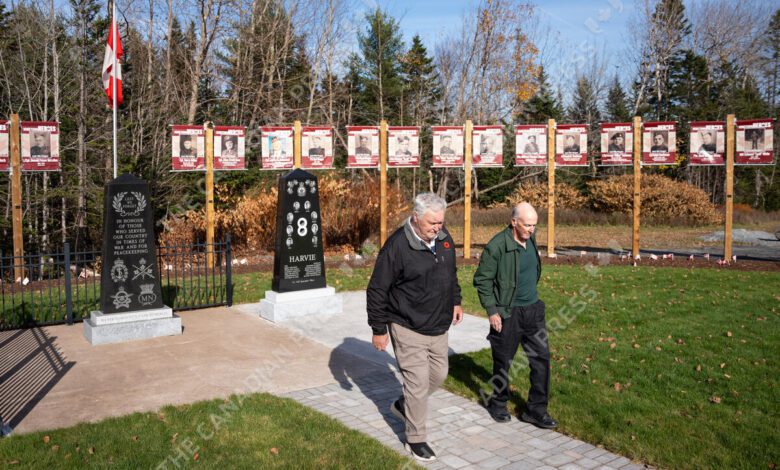
A black granite monument in Noel, Nova Scotia, now records the names and photographs of eight Harvie brothers from nearby Gormanville who served in Europe during the Second World War. Six returned to Canada; Marven and Burrell Harvie died overseas and were buried there.
Eight names restored to local memory
The monument identifies Avard, Burrell, Edmund, Ernest, Ervin, Garnet, Marven and Victor Harvie. A large numeral eight at its centre emphasizes the unusual scale of one family’s service while preserving each brother as an individual.
Royal Canadian Legion branch president Jeff Thurber learned about the family through a memorial book around Remembrance Day 2023. His discovery showed that history can be physically present in an archive yet absent from community awareness until someone returns to the record.
The brothers’ service
Marven, the youngest, served with the North Nova Scotia Highlanders and was killed in Germany in March 1945 at age 19. Burrell served in the Canadian Forestry Corps, was injured and died at 32 in 1942. He was buried in Surrey in the United Kingdom.
Garnet also served with the North Nova Scotia Highlanders and was wounded in Normandy after the D-Day landings. Ervin was in the tank corps, Avard in ordnance and Edmund in an artillery regiment. Ernest and Victor were also among the six who returned.
Unit names and dates provide verifiable structure, but a complete family history also needs service files, letters and descendants’ testimony. The experience of returning veterans should not be reduced to survival; wounds and war’s effects could continue long after demobilization.
A community-funded memorial
Residents raised about $30,000 for the project, including a $5,000 contribution from the local fire department. The monument stands beside the Legion branch in Noel, roughly 70 kilometres north of Halifax and close to the brothers’ home community.
Family members travelled from across Canada for the dedication. Their participation helped connect public commemoration with the people who hold personal records and memories.
What monuments can and cannot do
A durable marker protects names from disappearance and gives schools and families a place to gather. It cannot contain the full complexity of war, including civilian loss, political decisions and the experiences of people historically omitted from official commemoration.
Interpretive material can link the monument to archival sources and explain the brothers’ units and circumstances. Digital records should cite sources and avoid repeating family legend as confirmed fact.
Remembrance after delayed recognition
Thurber said the tribute should have appeared decades earlier. Its late construction demonstrates both a loss and an opportunity: local memory had faded, yet a small documentary clue allowed residents to rebuild it.
The Harvie story is striking because eight brothers served, not because family sacrifice can be ranked by a number. Every casualty and veteran had a distinct life. The monument succeeds when its central eight invites visitors to learn those lives rather than treating them as a statistic.
Placed near Gormanville, the memorial returns the brothers’ history to the landscape from which they left. Community fundraising, family involvement and documented names ensure that future remembrance begins with evidence and leads toward deeper inquiry.