India–MERCOSUR Talks Begin, but No New Trade Agreement Has Been Signed

India and the South American trade bloc MERCOSUR have announced the start of talks to expand their existing Preferential Trade Agreement, opening a potentially important new phase in commercial relations. The announcement is significant, but it should not be confused with a completed free-trade agreement. No new tariff schedule, market-access commitment, rules-of-origin text or implementation date has been published. For businesses and consumers, the immediate change is political and procedural: negotiations are beginning, not yet producing new trade preferences.
Commerce and Industry Minister Piyush Goyal and Uruguay’s Foreign Minister Mario Lubetkin announced the move on September 14. Uruguay holds MERCOSUR’s rotating pro-tempore presidency. The stated aim is to expand the existing India–MERCOSUR Preferential Trade Agreement, commonly called a PTA, which already gives selected goods lower tariffs than would otherwise apply.
A PTA is narrower than a comprehensive free-trade agreement. It does not necessarily remove duties on most trade, nor does it automatically cover services, investment, government procurement, digital trade or every product traded by the participating economies. It offers agreed preferences on specified tariff lines, subject to conditions such as product origin and customs documentation. That distinction is particularly important when large trade figures or ambitious political statements accompany a new negotiation process.
What the existing arrangement covers
India and MERCOSUR signed their framework agreement in 2003, while the current preferential arrangement entered into force in 2009. A formal parliamentary response has stated that the existing PTA covers about 450 tariff lines offered by India and 452 tariff lines offered by MERCOSUR, with preferences ranging from 10% to 100% depending on the product. That is meaningful coverage, but it is not the same as duty-free treatment across all goods or a completed economic partnership.
The next stage is the most consequential one: defining the terms of reference for an expanded agreement. Terms of reference set the scope and modalities of negotiations. They can establish which subjects will be discussed, how the talks are organised and what objectives negotiators will pursue. They do not themselves decide the final tariff reductions or guarantee market access for a particular industry.
That is why the September announcement should be read alongside India’s August 31 trade-monitoring meeting with Brazil. The Commerce Ministry said India and Brazil had reviewed progress on the India–MERCOSUR terms of reference and committed to their early finalisation. The ministry described the existing PTA as having considerable scope for expansion and modernisation. This suggests that the political decision to launch talks is in place, while detailed work on their framework and eventual outcomes continues.
Trade figures need the right context
Trade between India and MERCOSUR gives the discussions economic weight. The Commerce Ministry said India–MERCOSUR trade reached US$20.84 billion in calendar year 2025. That figure should not be confused with India–Brazil trade alone, which the same August release put at US$15.07 billion in 2025–26. Brazil is a central MERCOSUR economy, but bilateral India–Brazil trade and India–MERCOSUR trade are different measurements with different geographic coverage and time periods.
Past official statements indicate areas negotiators may seek to address, but they should not be reported as settled outcomes. A 2025 India–Brazil joint declaration said a deeper arrangement should aim to cover both tariff and non-tariff issues and enable a significant share of bilateral trade to benefit from preferences. It also called for technical dialogue and expressed an intention to try to conclude negotiations within a year of a formal launch. That language is a policy objective, not a signed deadline or a guarantee that agreement will be reached on every contested issue.
The August India–Brazil meeting also discussed pharmaceutical market access, agricultural phytosanitary processes, mutual recognition of electronic certificates of origin, and cooperation involving smaller businesses and crafts. These are relevant examples of trade frictions that governments may try to address. However, they do not amount to a final India–MERCOSUR package, and no one should assume that a product will receive lower duties or a regulatory shortcut until negotiated text is published and adopted.
The decisions that are still ahead
For Indian exporters, an expanded PTA could eventually matter in sectors where tariff preferences, predictable rules and simpler documentation improve competitiveness. For MERCOSUR producers, greater access to the Indian market could matter in their own priority products. Yet each prospective gain will depend on the final product lists, tariff phase-outs, safeguards, standards, rules of origin and domestic approval processes. Negotiators will also have to balance export ambitions with concerns from sectors exposed to greater import competition.
Several central questions are therefore still open. Which products will be included or excluded? Will the arrangement remain focused on goods, or grow into a broader economic agreement? How will agricultural, pharmaceutical and industrial standards be handled? What origin rules will companies need to meet? Will there be transition periods or safeguards for sensitive sectors? And how quickly will the parties move from political announcement to public negotiating text?
The September announcement is best understood as an opportunity to negotiate a larger and more modern preferential arrangement, rather than evidence that India has already secured a new free-trade agreement with MERCOSUR. The value of the process will ultimately depend on the published terms, the balance of concessions and whether businesses can use the resulting rules in practice.
Sources
- News on AIR: September 14 announcement
- PIB: India–Brazil Trade Monitoring Mechanism meeting
- PIB: 2025 India–Brazil declaration
- Parliamentary answer on the existing India–MERCOSUR PTA
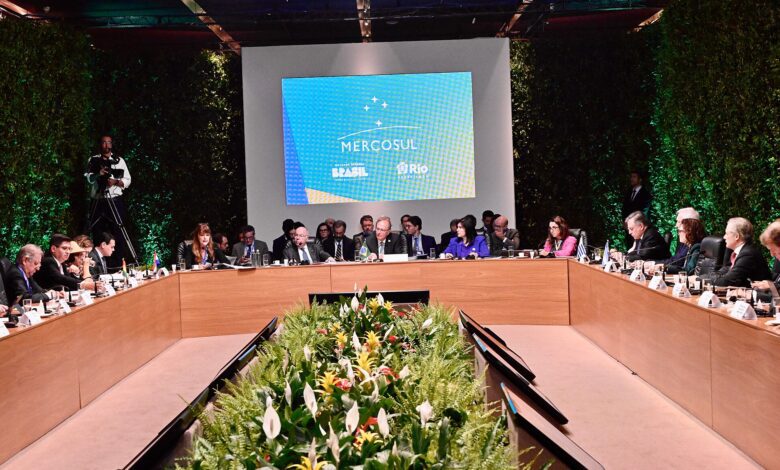
Featured image: official photograph from a 2023 MERCOSUR summit, Cadu Gomes/VPR, CC BY 2.0, via Wikimedia Commons. Archive image; it does not show the September 2026 India–MERCOSUR announcement.