Iran missile and drone exchange: what Jordan and the UAE confirmed

AMMAN, September 1 — A new exchange involving Iran, United States facilities in Jordan and an Iranian drone over United Arab Emirates waters has widened regional security concerns. The confirmed public record remains narrower than many social-media posts: missiles aimed at US sites in Jordan were reported intercepted, while the UAE said its air defences dealt with a drone over its territorial waters.
What is confirmed
An Associated Press report on the latest hostilities said Iran launched missiles toward US sites in Jordan and that the weapons were intercepted. The account available when this article was prepared did not provide a verified public basis for a precise missile count or confirmed casualty total, so neither is stated here.
Separately, Jordan’s Foreign Ministry issued a statement on August 31 condemning an Iranian drone attack directed at the UAE. The ministry said Emirati air-defence systems handled the drone over UAE territorial waters and described the incident as a violation of sovereignty and a dangerous escalation.
What should not be merged
The Jordan missile interception and the UAE drone incident are related parts of the regional confrontation, but they occurred in different airspace and involve different official accounts. A video of one cannot verify the other. Images of older missile launches, air-defence exercises or explosions elsewhere should not be relabelled as footage from either incident.
Why Jordan matters
Jordan hosts US military personnel and lies between several theatres of the conflict. Projectiles crossing or approaching its airspace create risks even when intercepted, because debris can fall and civilian aviation may be disrupted. Jordanian authorities have repeatedly framed protection of their territory as a sovereignty and public-safety issue rather than participation in another state’s war.
For the UAE, interception over territorial waters limits what can be inferred about damage on land. It does not make the launch insignificant, but it does mean that claims of a successful strike on an Emirati city require separate evidence.
This report will need revision if Jordan, the UAE, Iran or the United States publishes a detailed operational statement. Until then, casualty numbers, weapon counts and target names circulating without attributable evidence should be treated as unverified.
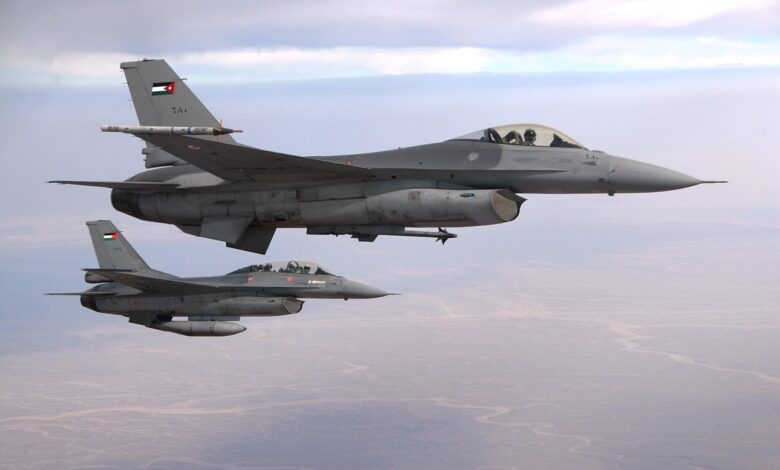
Archive photograph: two Royal Jordanian Air Force F-16 aircraft during a 2014 training mission. This is not the August 2026 interception. Photo: Caycee Cook, U.S. Air Force, Wikimedia Commons, public domain.