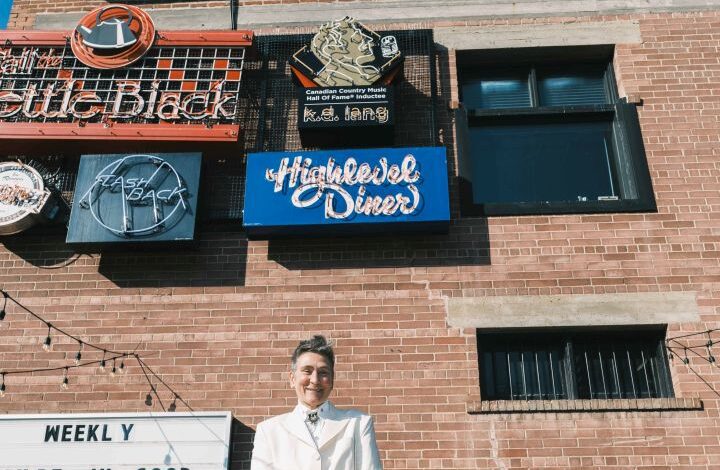
Edmonton’s outdoor Neon Sign Museum added a tribute to Grammy-winning singer k.d. lang in September 2024. The installation was the museum’s first sign devoted to an individual, linking an internationally known artist to the Alberta city where she was born and first performed.
The honour coincided with a homecoming
Lang visited Edmonton for the Canadian Country Music Association Awards after being inducted into the Canadian Country Music Hall of Fame. She performed with her original band, The Reclines, before an audience for the first time in 35 years.
The reunion made the museum dedication part of a broader celebration of her country roots.
The sign occupies a meaningful location
Curators placed the tribute beside the preserved Flash Back nightclub sign. The Edmonton gay bar was an important local venue where lang once performed, connecting her artistic beginnings with her later advocacy for LGBTQ rights.
The proximity turns two separate objects into a richer cultural narrative.
It expanded the museum’s usual approach
The Neon Sign Museum primarily preserves commercial signs that once advertised Edmonton businesses. Its collection is displayed outdoors on building walls, allowing people to visit without entering a conventional gallery.
Honouring a person broadened that mandate while retaining neon as the storytelling medium.
Several organizations collaborated
Explore Edmonton, the City of Edmonton, the museum, sign maker Blanchett and the country music association developed the project. Explore Edmonton released photographs of lang with the completed installation.
A future interactive element was planned to share stories about her life and work.
Her Alberta identity shaped her music
Lang was born in Edmonton and raised in Consort, a small prairie community. She began with a theatrical approach to country music before moving fluidly across pop, jazz and traditional standards.
That range resisted simple genre labels without severing her connection to the Prairies.
Her catalogue earned international recognition
Songs such as “Constant Craving” and “Miss Chatelaine” introduced lang to a global audience, while her voice and interpretations brought critical acclaim across several decades. Grammy and Juno awards documented industry recognition.
The museum honour focused equally on cultural influence and commercial success.
Public advocacy formed part of the tribute
Lang spoke openly about being gay at a time when doing so could threaten a mainstream career. She also supported animal rights and other causes, sometimes attracting controversy in cattle-producing Alberta.
Remembering those positions presents a fuller history than celebrating hit records alone.
Neon can preserve social history
Commercial signs often outlive the businesses and communities that created them. Conservation records typography, craft, nightlife, migration and changing attitudes within a city.
Placing lang’s name beside Flash Back acknowledges how performance spaces and queer communities contributed to Edmonton’s cultural life.
The display made recognition publicly accessible
Because the collection is outdoors, residents can encounter the sign as part of a downtown walk rather than a ticketed event. Interpretation will determine whether visitors understand the deeper connections behind its bright surface.
The installation honoured an Alberta musician at a moment of renewed country recognition, but its lasting value lies in linking personal achievement, local venues and social change. It made lang the museum’s first named individual while placing her within the city’s broader, evolving story.