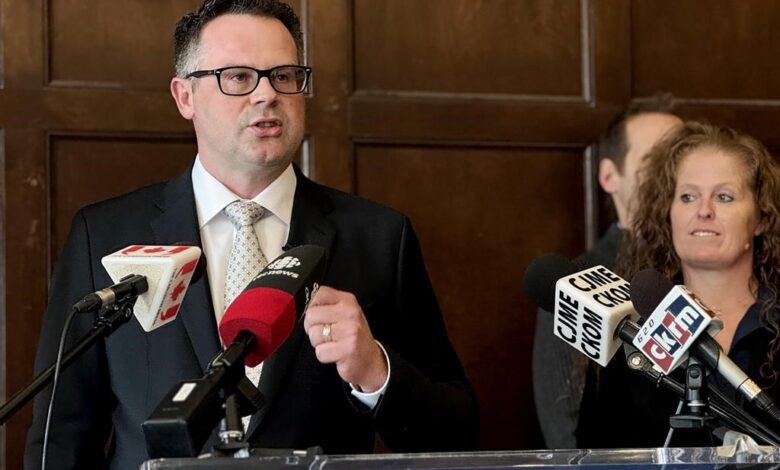
Saskatchewan United Party leader Jon Hromek opened his 2024 provincial election campaign by proposing to cut the provincial sales tax from six per cent to three per cent and eliminate the provincial gasoline tax. The promises offered a sharp affordability message but left voters needing a detailed account of the lost revenue and service choices.
The party positioned itself to the right
Hromek launched the campaign in Regina on October 2, presenting Saskatchewan United as a more consistently conservative alternative to the governing Saskatchewan Party. His immediate political objective was modest: win representation in the legislature and build a durable provincial organization.
The party had formed after the previous election and entered the campaign without an elected member. It therefore had to convert visibility on taxes and social issues into local support across the ridings it contested.
A three-point PST cut would be broad
Reducing the provincial sales tax to three per cent would lower the tax collected on covered purchases. A household would save three dollars on every $100 of taxable spending, while businesses could see lower costs on inputs to which the tax applies.
The benefit would not be distributed equally. Households that make larger taxable purchases save more dollars, while lower-income residents spend more of their income on necessities. Exemptions and refundable credits can target relief more precisely than a universal rate cut.
Revenue was the central unanswered question
PST supports health care, education, infrastructure and other provincial programmes. A rate reduction of half would remove a substantial recurring revenue stream unless economic growth, other taxes, borrowing or spending reductions filled the gap.
Campaign credibility therefore depended on a published costing and explicit priorities. Saying efficiencies would cover a promise is not the same as identifying which contracts, agencies or services would change and how quickly savings could be realized.
The gasoline-tax proposal had trade-offs
Eliminating the provincial fuel tax would provide visible relief each time a driver filled a tank. It could be particularly meaningful in rural and northern areas where travel distances are long and public transport alternatives are limited.
Non-drivers would receive little direct benefit, and lower pump prices can encourage fuel consumption. The policy also raises the question of how road construction and maintenance would be funded if dedicated or general revenue declined.
Affordability dominated the campaign
Every major party faced voters dealing with food, housing and transportation costs. Saskatchewan United argued that leaving more money with residents was preferable to government programmes and that the governing party had moved away from its fiscal roots.
Other parties proposed different combinations of tax relief, rebates and public spending. Comparing them required both the household benefit and the effect on the provincial balance sheet, not only the headline rate.
The proposal also tested a newer party
A challenger must show that it can recruit credible candidates, scrutinize legislation and operate beyond a single campaign issue. A dramatic tax promise may attract attention, but voters also evaluate health staffing, education capacity, agriculture and municipal relationships.
Saskatchewan United ran 31 candidates in the October 28 election. It received roughly four per cent of the province-wide vote but did not win a seat, and Hromek finished third in his constituency.
The result did not erase the policy question
The Saskatchewan Party returned to government, while the New Democratic Party formed a larger opposition. The tax debate continued because the pressures that gave the proposal resonance did not disappear after polling day.
Hromek’s plan was clear about the rate he wanted and less clear about implementation. A responsible assessment holds both ideas together: cutting consumption and fuel taxes could reduce some household costs, but the size and durability of those cuts required a transparent fiscal plan. Without that second half, voters could not know whether the eventual price would appear in reduced services, higher debt or another source of revenue.