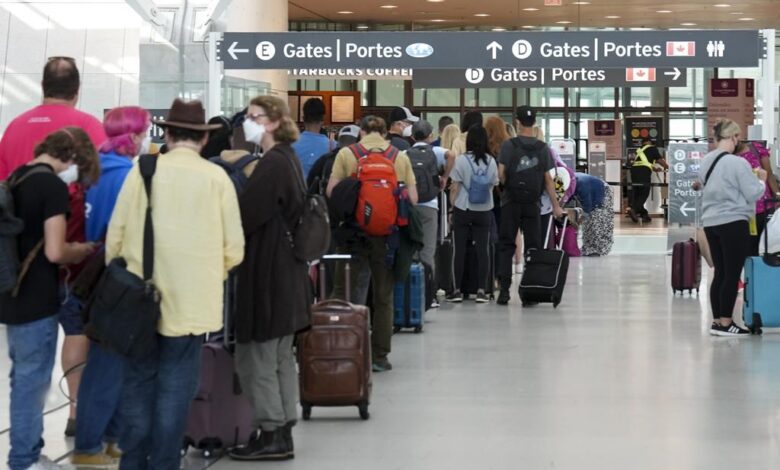
Canada’s airport security authority announced on September 18, 2024 that it would install computed-tomography scanners at passenger checkpoints over several years. The technology produces detailed three-dimensional views of cabin baggage and can reduce the need to remove some items during screening.
CT offers a more informative image
Traditional checkpoint X-rays present overlapping objects in a mainly two-dimensional view. CT systems capture many projections and reconstruct a rotatable three-dimensional image, helping screening officers examine suspicious areas without opening every bag.
Automated detection tools can assist the officer, but they do not replace judgment or secondary inspection.
Vancouver was the first deployment
The Canadian Air Transport Security Authority, or CATSA, began the national rollout at Vancouver International Airport. It planned installations at additional large airports, including Toronto Pearson and Montréal–Trudeau, followed by other locations as equipment and construction allowed.
A multi-year programme meant travellers would encounter different procedures at different checkpoints.
Passengers could leave more inside bags
At a CT-equipped line, CATSA said permitted liquids, aerosols and gels in their one-litre bag, as well as large electronics, could remain in carry-on baggage. Keeping laptops and small liquid containers packed can simplify divesting and repacking.
Travellers still had to follow the directions at the specific lane they entered.
The liquid limit did not disappear
The scanner announcement did not itself abolish Canada’s 100-millilitre-per-container rule. A passenger using a new machine could keep compliant containers in a bag, but could not assume that an oversized bottle had become permissible.
Security rules can change independently of equipment, so CATSA’s current guidance remains authoritative.
Installation involves more than buying machines
CT scanners are heavier and can require altered floors, conveyors, electrical supply, networking and checkpoint layouts. Officers need training, software must meet detection standards and every lane must integrate with airport traffic.
Those constraints help explain a phased rollout rather than simultaneous conversion nationwide.
Potential benefits require measurement
Better images may reduce manual bag searches and false alarms while improving the ability to identify prohibited items. Leaving belongings packed can also reduce congestion and the risk that passengers forget electronics at a checkpoint.
Actual throughput depends on staffing, lane design, alarm rates and how quickly travellers learn the procedure.
Privacy and accessibility still matter
The equipment images baggage, not passengers, but retention, system security and human access to scan data should follow clear policies. Screening instructions must also work for people with disabilities, language barriers or medical equipment.
Technology should not become a reason to reduce assistance or explanation.
Travellers should look for lane-specific instructions
During transition, a Canadian airport could have CT equipment on only some lines. A procedure followed on one trip might not apply at another airport or even another checkpoint in the same terminal.
The useful promise of CT is a more capable and potentially smoother screening process. It is not permission to ignore prohibited-item rules. CATSA and airports should publish deployment locations, wait-time effects, search rates and accessibility results so the public can judge whether a costly modernization delivers both security and convenience.
Passengers can help by checking current carry-on restrictions before travel and following the officer at the lane rather than relying on a social-media account of what the new scanner permits.