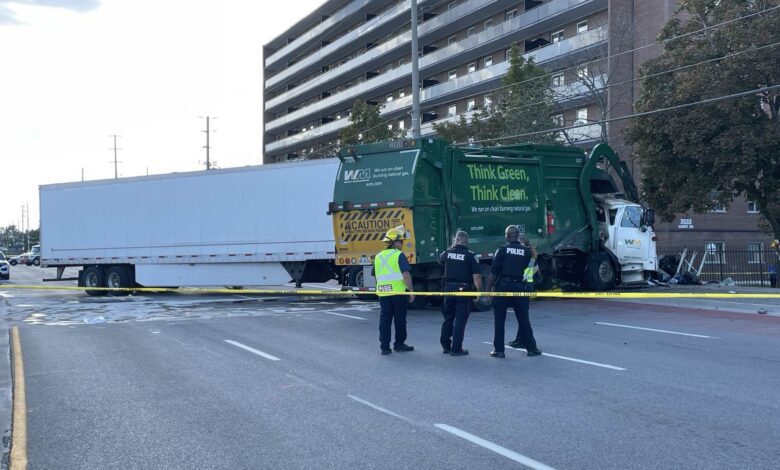
A woman driving a garbage truck died after a collision with a tractor-trailer in Mississauga, Ontario on September 26, 2024. The other driver was critically injured, and investigators appealed for evidence while warning that the cause had not yet been established.
Emergency crews responded in the afternoon
Peel Regional Police were called to Goreway Drive and Derry Road West shortly before 2:30 p.m. Paramedics, firefighters and police attended a scene with extensive damage to both heavy vehicles.
Life-saving measures were performed on two people. Both were transported to hospital, where the garbage-truck driver later died; the tractor-trailer driver remained in critical condition in the initial reports.
The intersection is a major freight area
Derry Road and Goreway Drive carry commercial and local traffic near industrial facilities and Toronto Pearson airport. A serious crash there can affect emergency access and movement across a wide area.
Police closures allow investigators to photograph debris, measure vehicle positions and protect responders. Drivers should use official detours rather than approach a restricted scene.
The cause was not immediately known
Early images can show the severity of impact but not which driver had the right of way, whether a mechanical problem occurred or what happened in the seconds before contact.
Responsible coverage avoids assigning fault until investigators assess witness statements, video, electronic vehicle data and physical evidence.
Two agencies had investigative roles
Peel police’s Major Collision Bureau investigated the road collision. Ontario’s Ministry of Labour was also expected to examine the death because the victim was working.
The inquiries address overlapping but different questions: possible traffic offences, the mechanics of the crash, workplace duties, training and vehicle safety.
Heavy vehicles create distinctive risks
Garbage trucks and tractor-trailers have greater mass, longer stopping distances and larger blind areas than passenger cars. Cab design, load distribution and turning paths can influence collision severity.
Those general facts should not be treated as an explanation for this crash. They identify evidence that investigators may examine.
Dashcam and witness material could help
Police asked anyone with relevant information or video to contact investigators. Useful recordings may begin before the collision and show traffic signals, lane movements or road conditions.
Witnesses should preserve original files with timestamps and avoid editing or repeatedly reposting graphic material. Direct submission protects evidentiary quality and the privacy of the people involved.
The death was also a workplace tragedy
Waste collection is an essential service performed around traffic, machinery and repeated stops. Employers have duties to provide safe vehicles, instruction and supervision, while road users must give large service vehicles adequate space.
A fatality can deeply affect coworkers and first responders as well as the driver’s family. Reporting should not reduce the victim to images of wreckage.
Verified updates matter more than speculation
Names are often withheld until relatives have been notified. Medical conditions and investigative findings can change after the first police statement.
The confirmed facts were limited but serious: two commercial vehicles collided, both drivers suffered critical injuries, and one died. Any later account should distinguish official findings from allegation and correct the record if initial information changes.