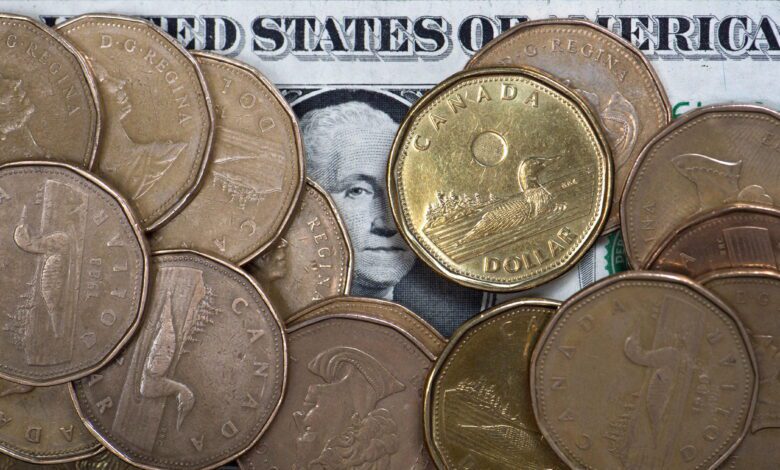
Donald Trump’s 2024 election victory prompted economists to examine how proposed U.S. tariffs, tax cuts and deregulation might affect inflation, interest rates and the Canadian dollar. The transmission was not automatic: campaign policies had to be enacted, markets could react in advance and Canada’s economy had its own forces.
Why U.S. inflation mattered
Broad tariffs increase the price of imported goods unless foreign suppliers absorb the cost through lower margins or exchange-rate changes. Tax cuts combined with strong demand can also add inflationary pressure, although the effect depends on their design and how government borrowing, investment and productivity respond.
Trump said inflation would disappear under his administration. Other economists warned that his policies could keep U.S. inflation higher and make the Federal Reserve cut interest rates more slowly than markets had previously expected.
The interest-rate gap
Just after the election, the Federal Reserve reduced its benchmark target range by one-quarter of a percentage point to 4.5–4.75 per cent. A TD Economics forecast cited at the time expected a slower 2025 path and a federal-funds rate ending that year at 3.5 per cent rather than three per cent.
That was a forecast, not a promise or present-day rate. Predictions should be preserved as what analysts expected in November 2024 and later judged against actual central-bank decisions.
If the Bank of Canada cut more rapidly than the Federal Reserve, Canadian-dollar assets could become less attractive at the margin, placing downward pressure on the loonie. Exchange rates also respond to oil prices, global risk, investment flows, productivity and expectations about economic growth.
How a weaker dollar reaches households
When the Canadian dollar buys fewer U.S. dollars, imported goods priced in U.S. currency become more expensive. That can affect food, machinery, electronics, travel and components used by Canadian manufacturers. Economist Sheila Block said this imported inflation could make the Bank of Canada more cautious about rapid cuts.
Brian Madden of First Avenue Investment Counsel argued the inflation effect might not be large. A weaker loonie can make Canadian exports more competitive, supporting demand and income for some producers. The benefits and costs are uneven: an exporter paid in U.S. dollars can gain while a household planning a U.S. trip pays more.
Central banks do not target currencies directly
The Bank of Canada sets its policy rate to achieve its inflation objective, considering a wide range of domestic and global data. It does not mechanically match the Federal Reserve or defend a fixed exchange rate. Currency weakness matters insofar as it changes inflation and economic activity.
Likewise, no president directly sets the Federal Reserve’s policy rate. Political decisions can alter the economic outlook, but the central bank makes rate decisions through its statutory process.
How Canadians could use the analysis
Borrowers should not change mortgages or investments solely because of one election forecast. Fixed and variable loans carry different risks, and individual decisions depend on income stability, time horizon and capacity to absorb higher payments. Currency speculation is particularly uncertain.
Businesses with U.S.-dollar expenses can measure exposure and consider contracts or hedging, while exporters should avoid assuming a favourable exchange rate will persist. Governments need scenarios for tariffs and retaliation rather than a single-point forecast.
The appropriate November 2024 conclusion was conditional. Policies that raised U.S. inflation could slow Federal Reserve easing, widen the rate gap, weaken the Canadian dollar and add some imported inflation in Canada. Every link in that chain depended on policy design and economic response. Presenting the mechanism with those conditions is more useful than claiming the election alone determined Canadian rates or the loonie.