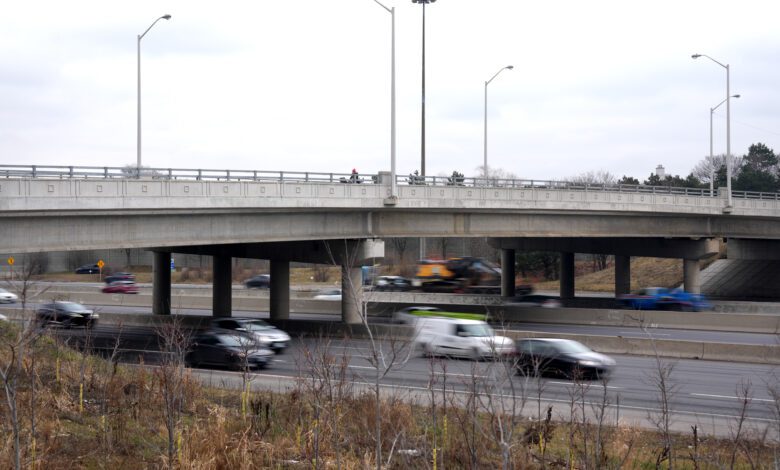
Ontario announced a feasibility study in September 2024 for a possible driver-and-transit tunnel beneath Highway 401 from west of Mississauga to east of Scarborough. Premier Doug Ford promoted the concept as a response to congestion but supplied no construction cost or final alignment.
The announcement began a study, not a project
The province said a technical evaluation would examine length, route, interchanges and whether transit could be included. No approved design, environmental assessment, procurement method or construction schedule existed.
Calling the tunnel “planned” at that stage would overstate the government’s commitment and available evidence.
The corridor carries enormous demand
Highway 401 through the Greater Toronto Area is one of North America’s busiest road corridors. Ontario cited estimates of 98 hours lost annually by an average Toronto-area commuter and C$11 billion in regional congestion cost.
Such estimates depend on models, but the daily delay is visible and economically important.
Tunnelling would be technically complex
A route tens of kilometres long would need portals, ventilation, emergency exits, fire protection, drainage, power, communications and connections to existing highways. Construction beneath an operating corridor also encounters utilities and varied ground conditions.
Safety standards for a mixed traffic-and-transit facility would require particularly careful separation.
Cost uncertainty was fundamental
Comparable megaprojects show that early estimates can rise as scope, land and engineering risks become known. Financing, maintenance and rehabilitation would continue long after opening.
A credible business case needed ranges, independent risk review and comparison with less expensive alternatives.
Added road capacity can induce traffic
A faster road initially attracts drivers who changed time, route or mode to avoid congestion. Development patterns may also encourage longer car trips, filling some new capacity.
Induced demand does not mean capacity has no value; it means forecasts must include behavioural response rather than assume today’s traffic is fixed.
Transit deserved equal analysis
The province said the study would consider transit, but a line within a highway corridor must connect conveniently with homes, jobs and existing networks. Stations and transfers determine usefulness more than a line on a map.
Regional rail, bus priority and subway expansion offered benchmarks against which a tunnel should be tested.
Nearer-term options remained available
Freight scheduling, incident management, toll policy, carpooling, remote work and improvements to GO Transit can affect congestion before a tunnel could open. Housing near employment and transit can reduce trip length over time.
A megaproject study should not delay investments with clearer benefits and shorter delivery periods.
Evidence had to precede a political decision
Ontario was justified in studying an idea if the study used transparent assumptions and genuine alternatives. It would be irresponsible to commit billions merely because a dramatic concept attracted attention.
The appropriate next milestone was a published feasibility and business case covering demand, climate emissions, safety, construction disruption and opportunity cost. Until then, the Highway 401 tunnel remained a proposal with an unresolved price and uncertain congestion benefit.
Any approval should follow public scrutiny of that evidence and a clear explanation of why the selected option outperformed alternatives.