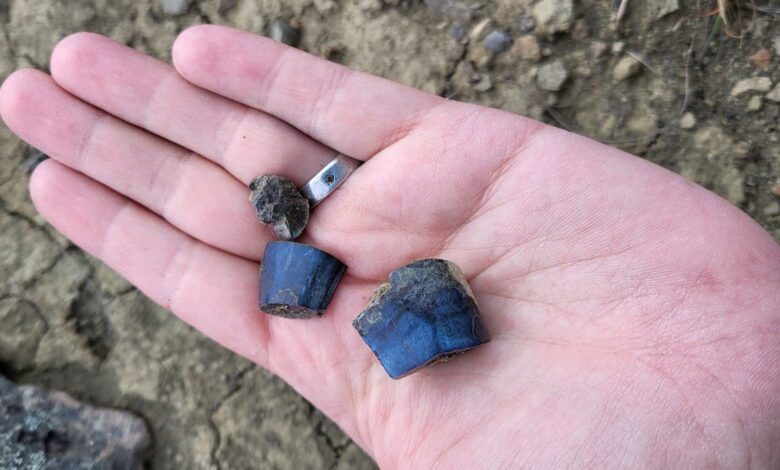
Royal BC Museum palaeontologists collected more than 90 dinosaur fossils during a 10-day expedition to the remote Spatsizi Plateau Wilderness Provincial Park in northern British Columbia. The specimens, roughly 66 to 68 million years old, offered a rare view of dinosaur life near the end of the Cretaceous Period.
The site lies in the Skeena Mountains
The team reached a high, isolated area of the park by helicopter, hundreds of kilometres from major population centres. Limited access and difficult terrain had left its fossil record less studied than southern Alberta’s famous formations.
Careful logistics allowed researchers to document context before removing material.
The collection represented several animals
Finds included teeth from a tyrannosaur relative, bones from at least one large plant-eating dinosaur and the foot of a small meat-eating dinosaur. Fossil plants and other material can help reconstruct the surrounding ecosystem.
Ninety fragments do not necessarily mean ninety individual dinosaurs.
Age came from the surrounding geology
Researchers place the deposits in the late Cretaceous using rock relationships, fossils and regional dating. Laboratory preparation and comparison refine the identification.
A preliminary field estimate should not be presented as a precisely dated day or year.
A new species was possible, not confirmed
Remote formations may preserve animals not represented in existing collections, and the team was excited by that possibility. Naming a species requires diagnostic anatomy, comparison with known specimens and peer-reviewed description.
Until that work is complete, “possible new species” is the accurate phrase.
Fossil preparation takes time
Technicians stabilize fragile pieces, remove surrounding rock and record each specimen. Researchers may use microscopy, imaging and anatomical measurement before determining which bones belong together.
Scientific value depends heavily on field notes and geological position, not just display quality.
The discovery expands British Columbia’s record
Much of the province’s exposed geology and mountainous terrain makes dinosaur remains harder to find than in Alberta’s badlands. Each well-documented locality helps map how animals and plants varied across ancient western North America.
Northern finds can test assumptions derived from southern sites.
Provincial parks protect research context
Collectors should not remove fossils from protected land. Unauthorized digging can damage a specimen and destroy information about its age, orientation and environment.
Members of the public who find material should photograph it in place, record location safely and contact the appropriate museum or park authority.
The headline number was only the beginning
The expedition’s significance will emerge through preparation, cataloguing and publication. Researchers must determine the minimum number of animals, taxonomic identities and how the bones were deposited.
The verified achievement was substantial without prematurely claiming a sensational species: more than 90 fossils from multiple dinosaurs were recovered from a scientifically underexplored, late-Cretaceous site. Their eventual contribution will come from open, peer-reviewed analysis and careful preservation in a public collection.
Public exhibits can share that process by showing uncertainty, preparation and changing identifications, not merely a finished skeleton. That approach teaches how palaeontology builds knowledge and why a modest-looking fragment can carry important evidence.
Researchers should publish catalogue numbers and geological context when the formal study is ready, enabling other specialists to reproduce comparisons.