BRICS New Delhi Declaration Sets Out Ambitions on Trade, Technology and Climate—But Not a Single New Deal

The 18th BRICS Summit in New Delhi concluded with a lengthy declaration covering global governance, trade, finance, technology, climate and development. The New Delhi Declaration was adopted during the summit held from 12 to 13 September 2026 under India’s chairship and the theme “Building for Resilience, Innovation, Cooperation and Sustainability.” It is a significant statement of common priorities for the grouping, but it should not be presented as a single new trade agreement, a common-currency launch or an instant programme of legally enforceable changes.
The document matters because it gathers a large number of policy areas into a common framework for an expanded BRICS. It also makes clear that much of the work remains prospective. Its language frequently welcomes, notes, encourages, supports or calls for cooperation. Those verbs are meaningful in diplomacy, but they do not by themselves create a new payment system, alter a tariff or finance an infrastructure project. Readers should distinguish between a joint position, an ongoing technical process and an action that has already been implemented.
The declaration says more than 400 meetings and engagements were held in 30 Indian cities during India’s BRICS chairship. It frames cooperation around three pillars: political and security cooperation, economic and financial cooperation, and cultural and people-to-people exchanges. Its overarching aim is to increase the voice of BRICS members and other emerging markets and developing economies in global decision-making.
Global governance and trade
Reform of global governance is central to that aim. The leaders reaffirmed support for a more just, equitable, agile, effective, representative and accountable multilateral system, with the United Nations at its centre. They called for greater participation and representation for emerging markets, developing economies and least-developed countries in global decision-making structures. The document also highlights the underrepresentation of developing countries in senior and decision-making positions at international organisations.
Trade and supply chains are another major focus. The declaration expresses concern about trade-restrictive actions that it says are inconsistent with World Trade Organization rules, including rising tariffs, non-tariff measures and protectionism framed as environmental policy. It says such actions can reduce global trade, disrupt supply chains and create uncertainty. The members said they would work together to strengthen the multilateral trading system’s responsiveness to trade disruption and the priorities of emerging markets and developing economies.
The text also looks at how smaller firms participate in cross-border commerce. It welcomes guiding principles for credit-assessment frameworks for export-oriented micro, small and medium enterprises, intended to reduce information gaps and expand access to formal finance. It also records the Jaipur Consensus to study an invoice-discounting mechanism for BRICS members. The stated objective is to help qualifying enterprises unlock working capital and participate more effectively in trade, but the declaration describes a study and policy direction rather than an immediately available facility.
What the declaration says about payments
Payments are an area where the declaration is deliberately measured. It acknowledges ongoing work by the BRICS Payment Task Force on practical cross-border payment mechanisms and references discussions about trade settlements and investment in local currencies. It does not announce a shared BRICS currency. Instead, it says members will continue discussions on cross-border payment solutions that are faster, lower-cost, more accessible, efficient, transparent and safe, while respecting national priorities and recognising that there is no one-size-fits-all approach.
Technology receives extensive attention. The declaration says artificial intelligence offers opportunities for economic growth and sustainable development, while stressing safety, security, inclusiveness and reliability. It notes cooperation on trustworthy AI technologies, AI science and innovation, energy efficiency and risk mitigation. It also acknowledges the Digital BRICS Forum 2026 and work related to digital public infrastructure. These sections set out a shared direction for cooperation, not a single AI regulator or a uniform set of rules that would apply automatically in every member country.
Climate, resilience and finance
Climate and disaster resilience are addressed through both broad commitments and named initiatives. The leaders reaffirmed support for the United Nations climate process and the Paris Agreement, while calling for predictable finance, technology transfer and capacity-building support for developing countries. The declaration welcomes BRICS guidelines on disaster-management early-warning data integration and voluntary principles for climate-resilient urban infrastructure. It also recognises that climate-related risks can damage infrastructure, livelihoods and human lives, particularly in the Global South.
The declaration contains detailed references to global finance as well. It calls for international financial institutions to be more representative, transparent and accountable, and it reiterates support for International Monetary Fund quota and governance reform. It records continuing technical discussions on a New Investment Platform and on a possible BRICS Insurance Resilience Centre. These are processes and proposals, rather than announcements that a new institution has begun operating.
The practical importance of the New Delhi Declaration will therefore be measured after the summit. A useful test is whether the working groups, finance officials, trade bodies and governments named or referenced in the text publish implementation steps that can be tracked. Potential indicators include progress on payment interoperability, trade-finance access for small businesses, disaster-warning data work, climate-resilient infrastructure cooperation and technical collaboration on trustworthy AI.
For India, the summit placed New Delhi at the centre of debates about multilateralism and development. For the wider grouping, the challenge is translating a broad diplomatic consensus into transparent, measurable cooperation. The declaration is an important political roadmap. Its longer-term value will depend on the concrete follow-through that members choose to report and deliver.
Sources
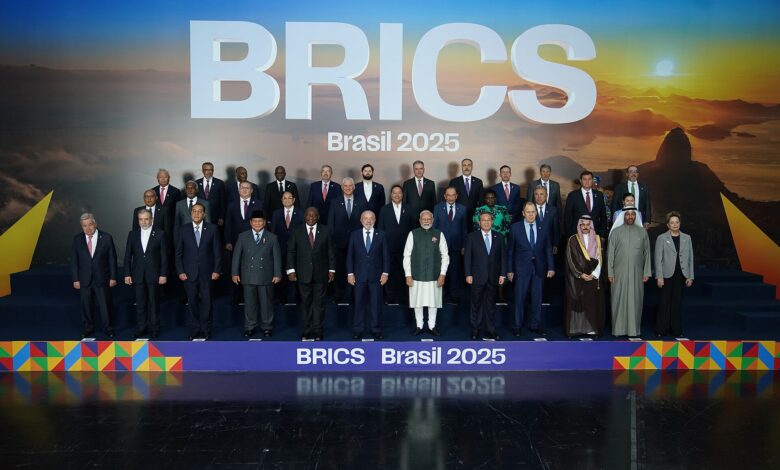
Featured image: official BRICS summit photograph from 2025, Cadu Gomes/VPR, CC BY 3.0, via Wikimedia Commons. Archive image; it does not show the 2026 New Delhi summit.