Regina’s Eagle Heart Centre gathered community members for its third annual truth-and-reconciliation awareness event on September 26, 2024. A memorial display of children’s shoes honoured those harmed by Canada’s residential-school system while the centre connected remembrance with education, culture and family support.
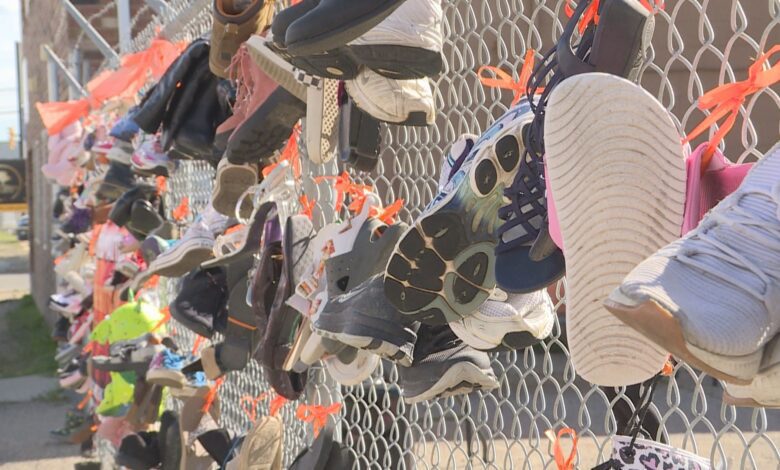
The shoe display began as a memorial
Executive director Mandy Bull said the first event placed shoes along the centre’s wall in memory of children associated with unmarked burials and those who never returned from residential schools. The image made absence visible without pretending to represent every individual story.
Organizers continued the practice as the gathering grew. Shoes can be emotionally powerful, but respectful interpretation must explain why they are present.
The event expanded beyond a single symbol
Participants could learn, talk and share cultural activities in a community setting. The centre’s broader work supports Indigenous children, youth and families through education, practical resources and healing programmes.
That continuity matters. Reconciliation is not confined to one observance or to institutions speaking about Indigenous people without their leadership.
Residential schools were an imposed system
For more than a century, governments funded schools that removed First Nations, Inuit and Métis children from families, often placing them under church administration. Children experienced suppression of language and culture, neglect and widespread physical and sexual abuse.
Survivor testimony, government records and the Truth and Reconciliation Commission establish the system’s purpose and harms. Accurate wording is important when discussing particular burial investigations, whose methods and findings vary by site.
Orange Shirt Day centres a survivor’s experience
The September 30 observance grew from Phyllis Webstad’s account of having her orange shirt taken when she entered residential school. “Every Child Matters” recognizes survivors, families and children who died.
Wearing orange should prompt learning and action, not function as a costume or marketing opportunity.
Community organizations create safer space
Indigenous-led centres can determine appropriate protocols and provide support when painful history is discussed. Participants should follow guidance about photographs, prayer, ceremony and the handling of memorial objects.
No survivor owes a visitor personal testimony. Listening without demanding disclosure is part of respectful participation.
Children need truthful, age-appropriate teaching
Families and schools can explain that institutions separated children from parents and tried to erase identities, while avoiding graphic detail that overwhelms younger learners. Books and materials by Indigenous authors help maintain perspective.
Education should also show living cultures, languages and communities rather than presenting Indigenous history only through trauma.
Healing includes practical support
Memorial events can direct attention toward counselling, language revitalization, child welfare reform and the implementation of the commission’s 94 Calls to Action. Governments and institutions remain accountable for measurable commitments.
Donations and partnerships are most useful when communities define priorities and retain control over programmes.
Honouring children requires sustained responsibility
The Eagle Heart Centre’s display invited Regina residents to pause, remember and learn. Its value came from the relationships surrounding it, not the visual impact of shoes alone.
After the event, participants could read survivor accounts, support Indigenous-led services and examine how present systems affect families. Remembrance becomes reconciliation only when it changes understanding, resources and conduct.