
Separated by the Ukraine War, Two Soul Mates Reconnect
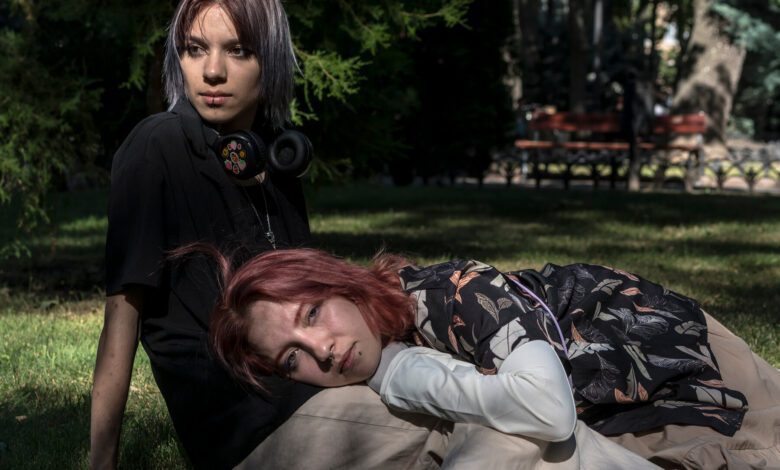
Sofia Malina and Polina Muzhychkova had known each other for only weeks when Russia’s full-scale invasion separated them in Mariupol in February 2022. One eventually reached Germany and the other Russian-occupied Crimea; two years of survival, secrecy and dangerous travel followed before they could build a life together again in Ukrainian-held territory.
Their relationship began before the siege
Malina first noticed Muzhychkova near Mariupol’s Drama Theatre in 2021 and later followed her art online. They met in January 2022 and formed a close bond as two young women navigating mental-health struggles and an environment where being openly LGBTQ could be difficult.
Weeks later, Russian forces encircled their home city. Ordinary plans gave way to finding water, shelter and a path out.
They survived different parts of the assault
Malina sheltered with her mother and grandfather on the city’s outskirts. She said Russian troops detained her and other women and girls in a basement for several days before releasing them.
Her family passed numerous checkpoints, reached Ukrainian-held territory and ultimately went to Germany. The safety of evacuation came with displacement and uncertainty about the person she loved.
Muzhychkova remained under bombardment
Muzhychkova stayed with her parents in an apartment-building basement for roughly two months, without normal heating or electricity and with dwindling food and water. She later travelled with her mother to Sevastopol in Russian-annexed Crimea.
Mariupol was devastated during an assault that killed civilians on a scale still difficult to establish. The theatre near which the women first connected was struck and heavily damaged despite sheltering civilians.
Digital contact crossed the front line
The pair continued messaging, but distance did not make departure simple. Muzhychkova had family obligations and lived in territory controlled by a government hostile to dissent and LGBTQ visibility.
Malina concluded that she could not safely organize the reunion from Germany. In 2023, she travelled through Russia to Crimea, initially using a visit to her estranged father as an explanation.
Reunion did not immediately mean freedom
Malina arrived with flowers, and the two began living together quietly. They worked, saved money and concealed both political views and the nature of their relationship from people who might expose them.
They obtained Russian documents required for everyday work or study in occupied Crimea. Possessing those documents in such circumstances does not by itself demonstrate free political allegiance.
A return to Mariupol showed what was lost
They visited the occupied city in 2023 to collect identity and property records. Reconstruction projects could not replace homes, relationships and livelihoods erased by invasion.
Muzhychkova’s father tried to rebuild his supply business, while she saw a place transformed beyond recognition. War divided families not only by borders but by incompatible accounts of responsibility.
Their exit carried new danger
In April 2024, the women began a long bus journey through Russia toward Ukraine without fully disclosing their plan to relatives. At the border, they said Russian officers interrogated and physically abused them, including questions about sexuality and political beliefs.
Russian authorities did not provide a public response to those specific allegations. Reporting them as the women’s testimony preserves both their account and the distinction from independently adjudicated fact.
They reached a shared life again
The pair arrived exhausted at a Ukrainian police post near Sumy and later worked as baristas in Odesa while planning to return to Germany. Their reunion did not undo trauma or resolve uncertain ties to family.
The story is intimate, but not apolitical. Invasion, occupation, displacement and anti-LGBTQ repression shaped every choice available to them. Their achievement was not a romantic escape from history; it was the recovery of agency inside it—the right to choose where to live, whom to love and how to describe the home that war took away.



