Dozens Feared Dead After Migrant Boat Sinks Off Canary Islands
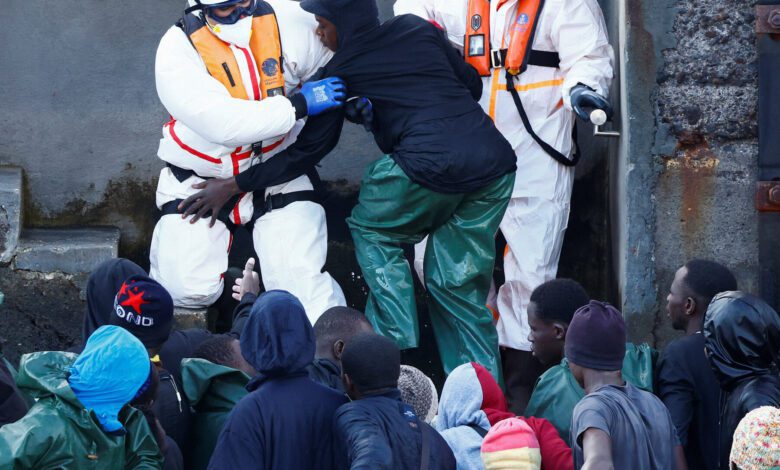
A wooden boat carrying people from West Africa capsized during a night rescue near Spain’s El Hierro island on September 28, 2024. Rescuers brought 27 people to safety and recovered nine bodies, while 48 people were reported missing, making the incident one of the deadliest recorded close to the Canary Islands.
The vessel had called for help
Spain’s maritime rescue service received an alert from a cayuco with 84 people aboard near the eastern side of El Hierro. The boat was only several kilometres from the island after a journey believed to have begun in Mauritania.
Passengers had reportedly spent days at sea with scarce food and water. Such vessels are usually open, overcrowded and poorly equipped for Atlantic conditions.
The boat overturned during the rescue
Authorities said people on board moved toward one side as the rescue vessel approached, causing the cayuco to capsize. The operation took place in darkness with gusting winds, leaving crews only minutes to pull people from the water.
That description explains the immediate mechanics but not the structural causes that placed so many people on an unsafe boat. It should not be used to blame exhausted passengers for their deaths.
A large search followed
Maritime rescue ships, helicopters, the Civil Guard, the Red Cross and Canary Islands emergency services joined the response. Twenty-seven survivors, including several minors, were rescued.
Nine deaths were confirmed in the first operation. The missing count was based on the reported number aboard and could not become a definitive death toll without recovery or other evidence.
The Atlantic route is exceptionally dangerous
The Canary Islands sit much closer to parts of northwest Africa than to mainland Spain. Routes from Mauritania, Senegal and farther south expose small craft to strong currents, wind, large waves and long periods beyond rapid rescue range.
When boats disappear without a distress call or passenger list, deaths may never enter official statistics. Recorded fatalities therefore provide an incomplete measure of the human loss.
Arrivals had risen sharply in 2024
More than 26,000 people had reached the Canary Islands by sea by the time of the disaster, substantially above the comparable period in 2023. El Hierro, with a resident population of roughly 11,000, had become a major reception point.
Local authorities faced pressure on shelters, health services and care for unaccompanied minors. Those logistical challenges did not reduce Spain’s obligations to rescue people in distress and process protection claims individually.
Passengers had different reasons for travelling
People using the route included Malians fleeing conflict as well as people from Senegal, Mauritania and other countries seeking safety or livelihoods. The legal status of a person cannot be determined from the boat on which they arrived.
Some may qualify for asylum, while others may not. Describing everyone simply as “illegal” erases that assessment and can dehumanize people before authorities hear their cases.
Policy extends across several countries
Spain and the European Union have funded border enforcement and cooperation with departure countries. Supporters say prevention disrupts smugglers and reduces dangerous launches; rights groups warn that deterrence can push people onto longer routes and expose them to abuse.
Safer legal pathways, functioning asylum systems, search capacity and action against exploitative networks address different parts of the problem. No single measure removes the forces driving movement.
The missing must remain visible
The immediate facts were 27 survivors, nine recovered dead and dozens unaccounted for. Each number represented a person whose family might receive no confirmed answer.
Accurate reporting should preserve uncertainty, avoid unsupported identities and recognize rescuers’ work without sanitizing the policy failure surrounding repeated loss at sea. The El Hierro disaster was not an isolated accident; it was a warning about a route where risk is predictable and many deaths remain undocumented.