School Bus Fire in Thailand Kills at Least 23 People
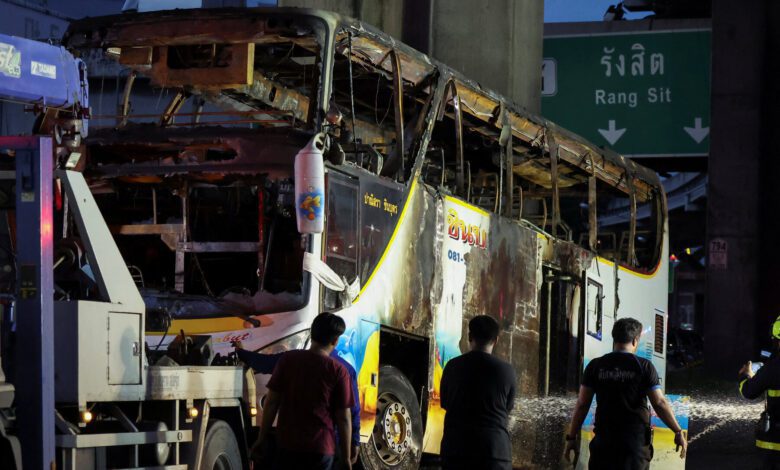
A bus carrying students and teachers on a school trip caught fire in Pathum Thani province north of Bangkok on October 1, 2024, killing 20 children and three teachers. Twenty-two people escaped, but the speed of the blaze trapped many passengers and triggered national scrutiny of vehicle modification, inspection and emergency exits.
The group was travelling from Uthai Thani
Six teachers and 39 elementary and junior-high students from Wat Khao Phraya Sangkharam School were aboard. The bus was one of several vehicles taking the group on an educational trip.
The fire began around noon on a major road in Lam Luk Ka district. Heat and the presence of compressed natural gas delayed rescuers’ access to the wreckage.
Early reports blamed a tyre
Officials initially said a front tyre may have burst, causing the bus to strike a barrier and create sparks. Later forensic examination found no evidence that a tyre explosion was the initiating event.
Investigators instead focused on a broken front axle or scraping near the road and a leaking gas line. The changing account shows why early disaster explanations should remain provisional.
The gas installation raised severe questions
Authorities found more compressed-natural-gas cylinders than were recorded in the vehicle’s registration, and reports described the bus as having been modified. A loose or damaged line was suspected of feeding the fire.
Natural gas can power vehicles safely when tanks, lines, valves and inspections meet standards. The fuel type alone did not explain why an apparently inspected school bus carried an unsafe installation.
Escape became almost impossible
The fire spread near the front of the bus, where a principal door was located. Survivors and investigators raised concerns about exits, window-breaking tools and whether children had practised evacuation.
School-trip safety must assume that adult supervisors may be injured and smoke can make a familiar exit unusable within seconds.
Police filed negligence-related charges
The driver was arrested on allegations including reckless driving and failure to assist, while the registered operator was charged with negligence causing death. These charges were subject to court proceedings and were not convictions at announcement.
Responsibility could extend beyond one person if inspectors, modifiers or company managers failed legal duties. That required evidence rather than public assumption.
The bus had passed an inspection months earlier
Reports that the vehicle passed inspection about four months before the fire intensified concern about the quality of checks and the accuracy of documents. Other buses linked to the operator were examined as authorities searched for similar unregistered cylinders.
An inspection programme is credible only if it can detect hidden modifications and penalize false records.
Thailand suspended trips and ordered checks
The government directed safety inspections of natural-gas buses and reviewed school-excursion practices. Immediate checks can remove dangerous vehicles, but sustained enforcement is needed after public attention fades.
Contracts should verify licensing, driver hours, maintenance, insurance, seat capacity and emergency equipment rather than select the lowest bid alone.
The deaths were preventable, not an unavoidable accident
The final technical and criminal allocation of responsibility belongs to investigators and courts. The established facts already identify multiple protective layers that failed: vehicle integrity, fuel-system documentation, inspection and evacuation.
Remembering the victims requires more than graphic images of the wreck. Thailand’s response should make school transport auditable, require working exits and drills, and protect inspectors from pressure. When children board an approved vehicle for a school activity, families are entitled to expect that every layer of safety has been tested in reality, not only recorded on paper.