
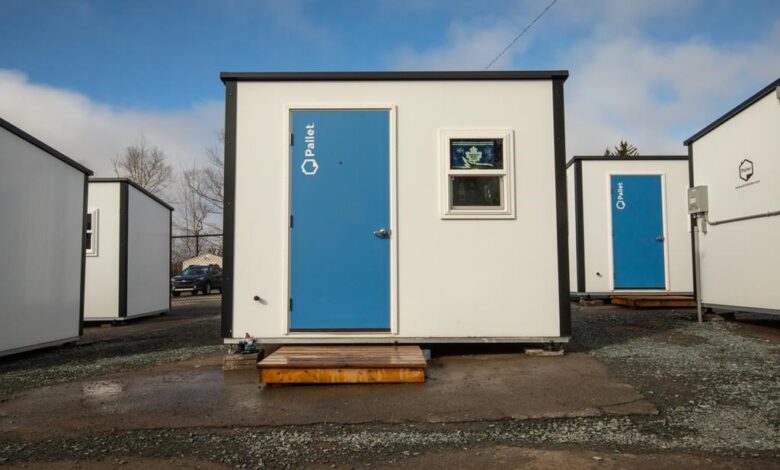
Only 80 of the 200 individual shelters purchased by Nova Scotia for people experiencing homelessness were open by October 1, 2024, almost a year after the C$7.5-million initiative was announced. The province said work continued on the remaining units, while advocates questioned why promised winter capacity had taken so long to reach residents.
The units were intended as shelter villages
The insulated fibreglass cabins, manufactured by Pallet, provided approximately 70 square feet of private space for one person. They were grouped at supported sites rather than distributed as independent permanent homes.
A locked room offers privacy and protection that a congregate mat cannot. It still lacks the space, tenancy security and full facilities associated with permanent housing.
Buying a structure was only the first step
Each site needed land, utilities, permits, fire review, washrooms, staffing and a service provider. Community consultation and procurement added further time.
Those requirements explain why 200 prefabricated cabins could not open immediately. They do not excuse unrealistic announcements that counted units before viable sites and operators were secured.
The initial timetable slipped past winter
When the province announced the purchase in October 2023, it said vulnerable residents would benefit during the approaching winter. By the following October, 120 units remained unavailable.
The province identified 85 for additional Halifax Regional Municipality locations and 35 for Whitney Pier in Cape Breton. Delays left emergency shelters and encampments carrying continued demand.
Support services determined whether villages worked
Residents could need outreach, health care, income assistance, harm reduction, storage and help obtaining identification or housing. A cabin without reliable staffing may protect against weather without creating a route out of homelessness.
Rules also matter. Couples, pets, accessibility needs and curfews can determine whether an available space is realistically usable for a particular person.
The remaining villages later opened
Whitney Pier began welcoming residents in November 2024, and additional Halifax-area sites opened in January 2025. Provincial reporting later listed six villages with capacity for up to 200 people: 20 units in Kentville, 35 in Sydney and 145 across four Halifax Regional Municipality locations.
That completion is important context, but it does not make the year-long deployment delay inconsequential.
Temporary shelter cannot replace housing
Emergency villages can reduce exposure, improve sleep and create a stable contact point for services. They should not become a permanent substitute for apartments with enforceable tenant rights.
Moving people from visible encampments into small cabins may improve safety, but success should be measured by health, stability and transitions into lasting housing—not only by cleared public space.
Cost comparisons require the full programme
The purchase price was only part of the expenditure. Site preparation, utilities, security, staffing and operation continue after a unit arrives.
Permanent supportive housing has higher capital requirements but creates a durable asset. Governments should compare long-term outcomes rather than choosing emergency structures because the initial unit appears inexpensive.
The programme eventually reached its announced scale
As of the original report, the criticism was justified: fewer than half the purchased shelters were serving residents and the promised timetable had been missed. Later openings show that the other units were not simply abandoned in storage.
The balanced conclusion is that Nova Scotia created useful supported shelter capacity but announced it before resolving critical delivery details. Future emergency-housing programmes should secure sites and operators early, publish milestone dates and build a funded path into permanent housing. A private cabin can be a humane bridge; it should never be mistaken for the destination.



