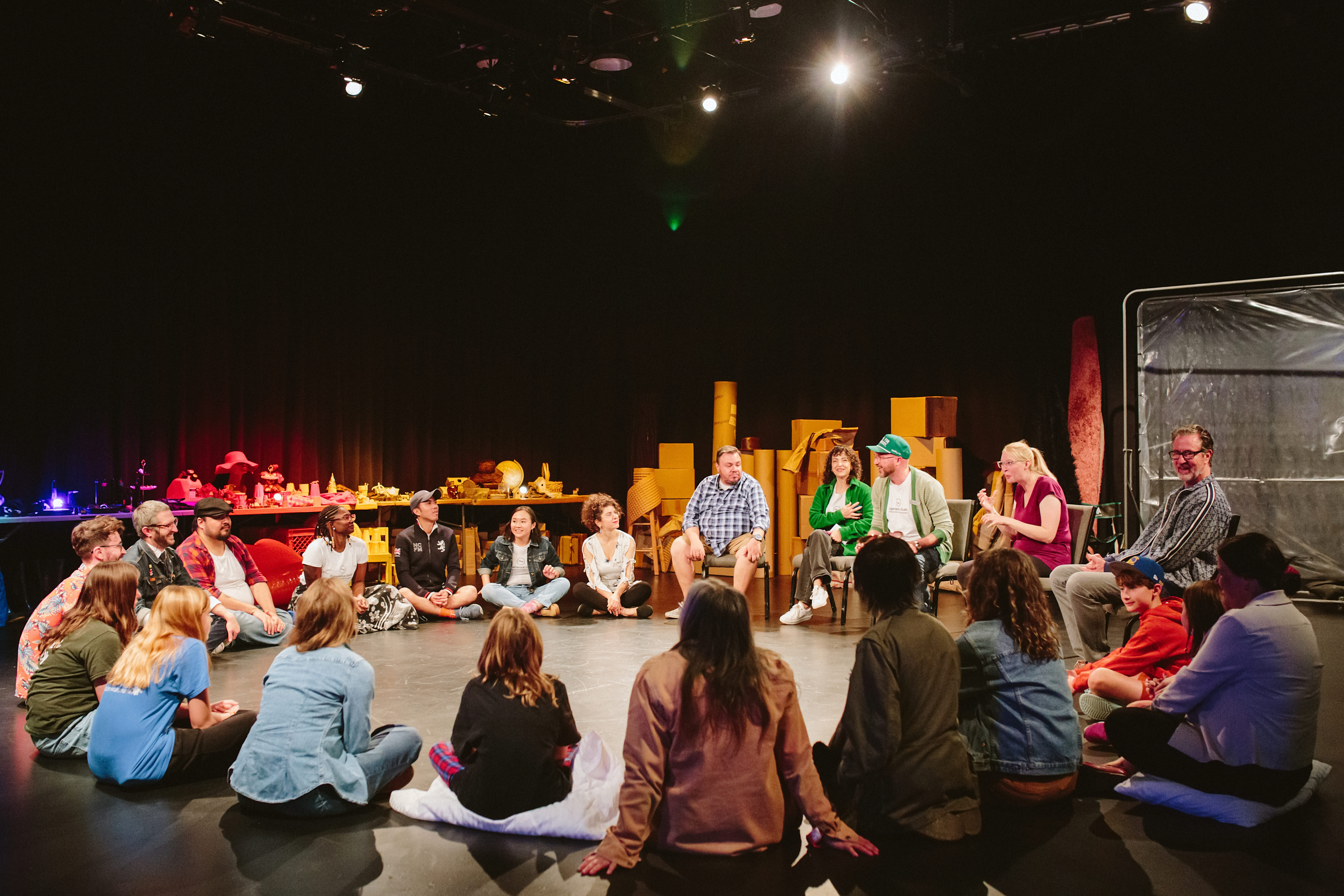
Ghost River Theatre’s The Room Sculpture Experience turned audience members into collaborators rather than spectators. In a darkened Calgary performance space, groups used more than 1,000 ordinary and oversized objects to construct and then dismantle a temporary sculpture without spoken conversation.
The performance had no fixed visual outcome
Participants encountered pebbles, mannequins, inflatable forms and other materials. One person could place an object, another could build on the choice, and someone else could remove or redirect part of the emerging structure.
Because the work depended on each group, no two sessions produced the same sculpture. The creative process, rather than a permanent object, was the performance.
Silence created a different form of attention
Without spoken instructions between participants, people had to observe movement, gesture, spacing and the decisions already made in the room. Leadership could pass from one person to another without a formal debate.
Silence did not mean the absence of communication. It made visual and physical choices the shared language and allowed participants to respond before explaining.
The format lowered a common artistic barrier
Creator and artistic director Eric Rose said he wanted people to make art without needing drawing technique, specialist equipment or pressure to produce a polished item. Materials and a simple structure provided an entry point.
That does not eliminate every access need, but it challenges the assumption that audience members must arrive with training before they can participate creatively.
Ebony Gooden led Deaf-centred sessions
Deaf artist Ebony Gooden guided designated performances on October 4 and 5. Her leadership placed Deaf experience at the centre of the room rather than adding interpretation to a hearing-led event after it was designed.
Gooden had described fighting for accessibility after moving to Calgary. The production gave practical form to her argument that people can learn to listen beyond voice.
Accessibility shaped the programme
The run included a relaxed performance as well as Deaf-led sessions, and the West Village Theatre listed wheelchair access. A relaxed format can permit movement, sound and different audience responses without the behavioural expectations of a conventional auditorium.
No single accessible performance serves every disability. Clear advance information about light, sound, mobility, communication and assistance lets each person decide what support is needed.
The piece grew from school workshops
Ghost River Theatre piloted the concept with students in 2023 and expanded it for public and school performances in September 2024. Participants from upper elementary through high school could explore collaboration and spatial storytelling.
A maximum group of about 35 preserved enough room for individual decisions to remain visible. Scale was part of the artistic design, not only a ticketing limit.
Destruction was part of creation
At the end, the group dismantled what it had built. That instruction removed the pressure to protect a final masterpiece and emphasized that art can reside in attention, negotiation and shared time.
It also raised questions about attachment and authorship: no participant owned the sculpture, and everyone helped make its disappearance.
The experience broadened the meaning of theatre
There was no conventional script, character or seated audience, yet the event used timing, space, light, participation and a guided sequence. Its drama came from watching collective decisions change the room.
The production’s achievement was not that it solved accessibility. It designed silence and participation as artistic strengths, gave Deaf leadership a defined place and offered multiple entry points. That approach moves inclusion from an accommodation at the edge of a performance into the material from which the performance is made.