
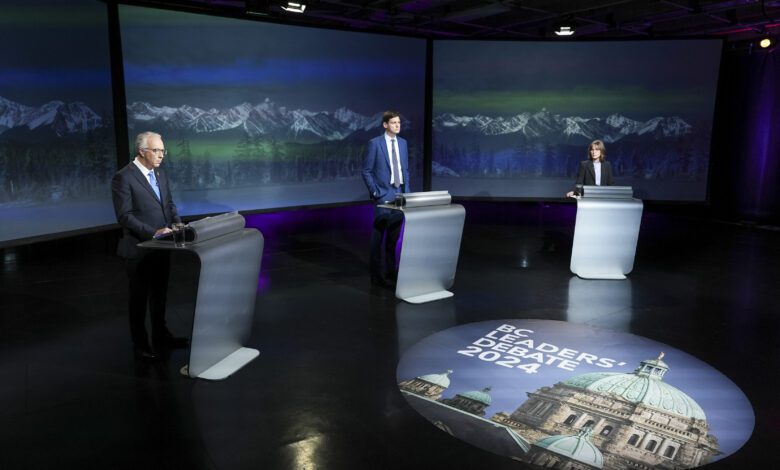
An Ipsos poll conducted after British Columbia’s televised leaders’ debate placed the incumbent New Democratic Party five percentage points ahead of the BC Conservatives in October 2024. The provincial headline concealed a much tighter contest in Metro Vancouver and a large group of undecided voters.
The poll’s main findings
Among decided voters, 46 per cent supported David Eby’s NDP, 41 per cent backed John Rustad’s Conservatives and 10 per cent chose Sonia Furstenau’s Greens. Twenty-one per cent of all respondents said they remained undecided.
The survey suggested the leaders’ debate had produced little immediate movement. That did not mean the campaign was settled: eight days remained before voting day, and undecided voters could change both the popular vote and close constituency races.
Regional differences mattered
The NDP and Conservatives were tied at 46 per cent in Metro Vancouver. The NDP led 52 to 32 on Vancouver Island and 43 to 38 in the poll’s combined North and Interior region.
Provincial elections are decided seat by seat, not by a single province-wide vote. A party can lead overall by accumulating large margins in safe districts while losing enough close races elsewhere to miss a majority.
How to read a poll
A survey is an estimate taken from a sample at a particular time. Its accuracy depends on sampling, weighting, likely-voter assumptions, question wording and whether late campaign events change opinion.
Regional subsamples contain fewer respondents and therefore more uncertainty than the province-wide figure. A reported tie does not prove that support was exactly equal in the entire Metro Vancouver electorate.
An unusual political realignment
The BC Conservatives entered the campaign after rapid growth and the suspension of BC United’s campaign. Many candidates and voters were navigating a new two-party contest without a recent constituency-level record for the Conservatives.
The Greens retained concentrated support in parts of Vancouver Island. Even a modest province-wide share could matter where the party was competitive or where Green voters affected the margin between the two larger parties.
The final week tightened further
A final Ipsos poll released on October 18 reduced the NDP’s estimated advantage to two points. That movement was consistent with a close race, but comparisons between surveys also include normal sampling variation.
Forecasts should therefore have expressed ranges and seat uncertainty rather than presenting either party as assured of forming government.
What voters decided
The October 19 result was exceptionally close. After the final count and recounts, the NDP won 47 of 93 seats, the Conservatives 44 and the Greens two. The NDP formed a bare majority government.
The province-wide popular vote was also close, with the NDP at roughly 44.9 per cent and the Conservatives at about 43.3 per cent. The poll correctly captured the competitive two-party structure and the NDP’s narrow edge, though no single survey could identify every decisive riding.
The useful lesson
Polls can show direction, demographic differences and where campaigns should be cautious. They cannot replace ballots, and a five-point lead among decided voters should never be reported without the undecided share, field dates and regional uncertainty.
The post-debate survey was informative because it showed both an NDP advantage and the conditions under which that advantage could disappear. The eventual one-seat majority confirmed the central message: British Columbia was not heading for an easy victory, but for a contest in which small shifts and local results would determine the government.



