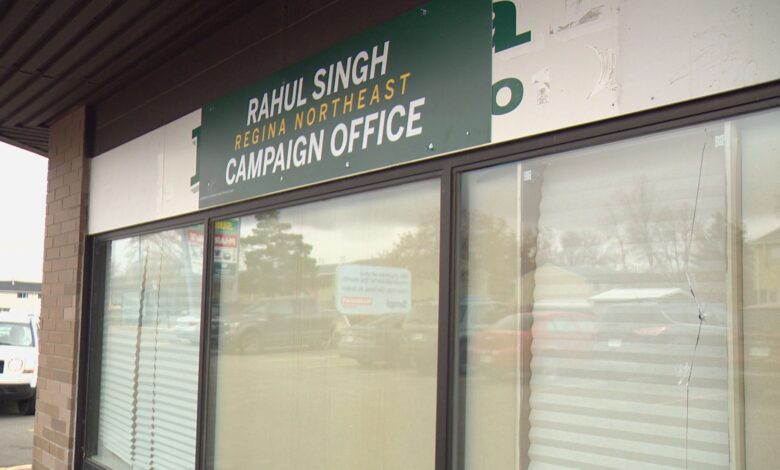
The Saskatchewan Party initially said two apparent bullet holes had been discovered in the window of candidate Rahul Singh’s Regina Northeast campaign office in October 2024. Regina police investigated and reported the same day that the damage was not caused by a firearm.
The initial alarm
Officers were called at about 7:20 p.m. on October 21 to the 1600 block of Dewdney Avenue. The holes appeared serious enough that the party and candidate believed gunfire might have targeted the office.
Singh said campaign signs had already been stolen and that the new damage left volunteers shaken. Given the possibility of a weapon, reporting the concern promptly was reasonable.
Police corrected the central claim
After examining the scene, Regina Police Service said the damage did not result from a firearm discharge. The matter remained under investigation, meaning authorities had not yet publicly explained the cause or identified a responsible person.
That update fundamentally changed the story. A headline or social-media post repeating only the party’s first description would wrongly leave readers believing a campaign office had been shot.
Political reactions before the update
Saskatchewan Party leader Scott Moe said targeting any campaign was unacceptable and praised Singh for continuing to canvass. NDP leader Carla Beck said no politician should face violence and expressed concern for the candidate, staff and volunteers.
Those responses reflected the information available when firearm damage was suspected. Correcting the factual premise does not make concern for campaign safety improper, but it means later accounts should not describe a shooting.
Why verification matters during elections
Claims involving political violence spread quickly because they can reinforce fear and partisan narratives. Photographs of holes in glass cannot reliably identify the object, force or intent that caused them.
News organizations and parties should update social posts as prominently as the initial alarm, link to the police finding and avoid implying a motive before evidence exists.
Protecting campaign workers
Campaign offices can still face theft, vandalism, harassment and threats. Parties should document incidents, preserve video, establish check-in procedures for canvassers and tell volunteers not to confront suspected offenders.
Police should assess threats consistently regardless of party. Public officials can condemn intimidation without speculating about an opponent’s supporters or using an unresolved incident for political advantage.
The presumption of innocence
No suspect had been identified in the available report. Damage to property is not proof of an organized political attack, and a person should not be accused based on proximity, online speech or party affiliation.
If charges are eventually laid, allegations remain unproven until tested in court. If no culprit is found, the absence of an answer does not revive the disproven firearm theory.
A case study in correcting breaking news
The episode moved from a plausible initial fear to a specific police correction within hours. Both stages belong in the record, but they do not carry equal weight after investigators examined the scene.
The accurate conclusion is straightforward: two holes were found in Singh’s office window, political leaders expressed concern, and police determined they were not bullet holes. Preserving that correction is essential to public safety, electoral trust and fair reporting.