
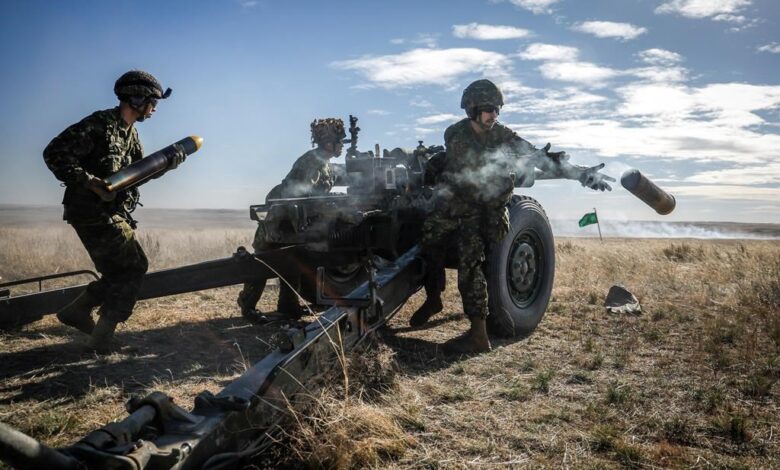
One hundred and fifty-eight Army reservists from Alberta and the Northwest Territories trained at Canadian Forces Base Suffield in November 2024, with many hoping to join Canada’s NATO deployment in Latvia. Their weekend exercise combined artillery, armoured reconnaissance and infantry skills with a message that reservists would be essential to sustaining Canada’s long-term European commitment.
Training at Canada’s largest military range
CFB Suffield lies about 260 kilometres southeast of Calgary and covers roughly 2,700 square kilometres. Its scale allows live-fire exercises to be separated from other activity. During the reported weekend, 105-mm howitzers and C6 machine-gun training formed part of the programme.
The participants belonged to 41 Canadian Brigade Group and ranged from 18 to 49. As part-time soldiers, they also held civilian roles including teaching, manufacturing tactical gear, private investigation and mountain guiding.
Why Latvia shaped the exercise
Canada leads a NATO multinational formation in Latvia as part of the alliance’s deterrence and defence posture on its eastern flank following Russia’s aggression against Ukraine. A continuing deployment needs rotations of trained personnel rather than a one-time contingent.
Brigade commander Colonel Chris Hunt told newer soldiers to complete qualifications that would make them eligible for planned rotations in 2027 and 2028. His warning that events could quickly require full-time service expressed operational urgency, not an announcement that every reservist at Suffield had been mobilized.
Reservists’ different paths
Captain Peter Rosendal, a Southern Alberta Light Horse member and former high-school teacher, was preparing for a six-month Latvia deployment and promotion to major. He had served in the reserve from 1986 to 2000, left and later repeated basic training after rejoining.
Major Brent Peters combined service in the King’s Own Calgary Regiment with work as a mountain guide and had deployed to Bosnia-Herzegovina and Afghanistan. Younger members such as Rhys Dunnill Jones and Zachary Fowler described a desire to develop skills and serve overseas, while Raymond Chow viewed a possible deployment as a longer-term goal.
Readiness is more than enthusiasm
Motivation matters, but overseas service requires medical and occupational qualification, unit readiness, equipment and family and employer support. Reservists may leave civilian work for months. Predictable notice and legal job protection help Canada draw on their skills without imposing avoidable hardship.
Live-fire proficiency is only part of a NATO mission. Personnel also train in communications, logistics, rules of engagement, first aid, cyber awareness and cooperation with forces speaking different languages and using different equipment.
What the exercise demonstrated
The Suffield weekend showed a geographically dispersed reserve formation practising at scale and preparing members for potential selection. It did not prove that every recruitment, procurement or readiness gap in the Canadian Armed Forces had been solved.
Hunt said the Latvia commitment would require reservists alongside regular-force colleagues over the long term. Fulfilling it responsibly means matching political commitments with trained people, serviceable equipment and care before, during and after deployment. The participants’ eagerness was real; the institution’s task was to convert it into sustainable readiness rather than rely on enthusiasm alone.
Readiness must also be demonstrated repeatedly.



