A Berlin collective brought yodelling into street protest in 2024, challenging the assumption that the vocal tradition belonged only to conservative Alpine identity. The group Jogida used humour and deliberately political lyrics while opponents of abortion marched nearby.
Alpine sounds reached central Berlin
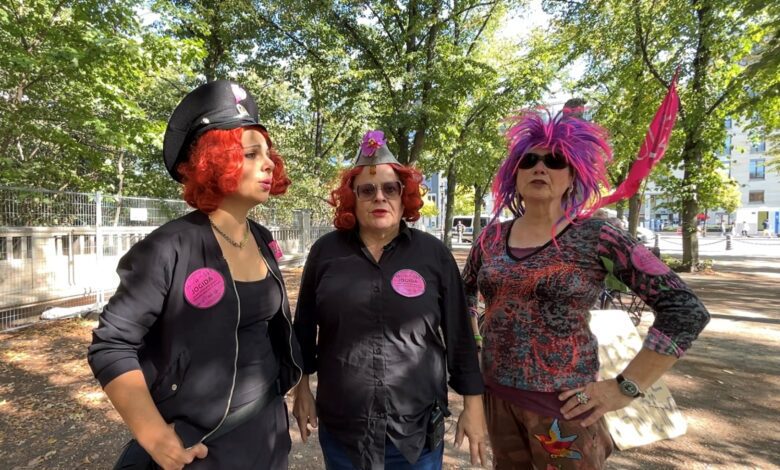
Members Elena Guzman, Gaia Schulze and other singers performed in Tiergarten park near the Brandenburg Gate. Between the familiar jumps from chest to head voice, they inserted an anti-AfD slogan.
The Alternative for Germany, or AfD, is a right-wing political party. The singers described their action as a response to an anti-abortion “march for life” and to their broader fear that far-right politics could narrow personal freedom.
The protest connected voice and politics
Guzman said yodelling allows a singer to raise and free the voice, making collective performance a natural form of political expression for the group. Schulze said singing with others offered an alternative to experiencing political anxiety alone through a screen.
The performance was confrontational, but it was also intentionally playful. Police asked the group to move, and the singers continued elsewhere. The episode illustrated how sound in public space can become both art and protest.
“Reclaiming” meant refusing one ownership claim
Yodelling is strongly associated with folk cultures in Switzerland, Austria and southern Germany, although related techniques exist in other musical traditions. In popular imagery it can be reduced to mountains, traditional clothing and rural conservatism.
Jogida argued that no political movement should own the technique. Reclamation did not require rejecting tradition; it meant using the form for feminist, anti-fascist and inclusive messages that some audiences do not expect to hear through it.
German folklore carries historical weight
Music researcher Sydney Hutchinson said the Nazi regime had used folk music, group singing and outdoor activities for nationalist indoctrination. That history helps explain why contemporary artists scrutinize the political meanings attached to traditional forms.
It would still be inaccurate to label yodelling itself extremist. A technique has no single ideology. Its meaning depends on lyrics, setting, institutions and the people who perform and hear it.
Experimental artists widened the form
Berlin performer Doreen Kutzke began working as a yodel MC as a teenager and later mixed yodelling with techno in clubs. She performed and taught internationally, exploring unusual spaces and compositions based on the contours of landscapes.
Her practice challenged embarrassment and the belief that folk performance must be preserved unchanged. Innovation can keep a tradition alive by letting new generations use it without impersonating a nostalgic past.
Cultural participation is not political proof
It would be simplistic to treat a yodeller as conservative or a modern arrangement as progressive. People participate for musical, family, regional and social reasons. Reclaiming culture works best when it invites participation rather than replacing one ideological purity test with another.
Political protest also deserves the same scrutiny as any other public action: clear attribution, lawful conduct and respect for people who did not consent to harassment.
A tradition can hold disagreement
Jogida’s performance mattered because it exposed an assumption about who gets to sound authentically German. Their answer was that a liberal, plural society could sing in a traditional register without accepting exclusionary politics.
The result was neither a complete history of yodelling nor evidence that the art had changed sides. It was a vivid example of culture as contested public space—where inherited forms can carry difficult history, humour, dissent and new community at the same time.