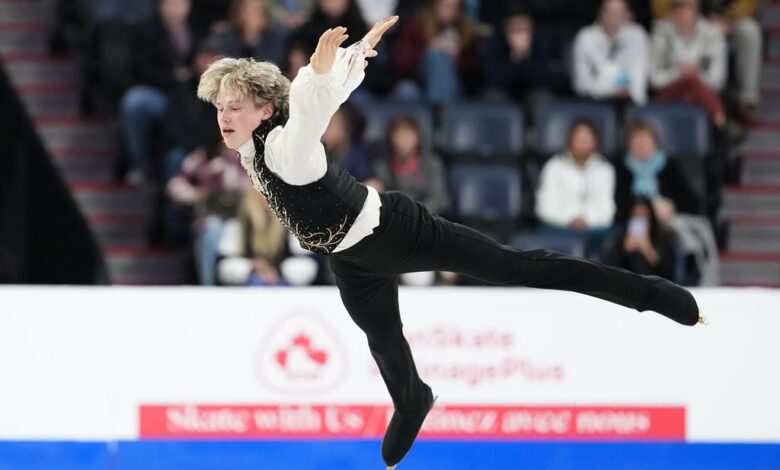
Reigning world champion Ilia Malinin won the men’s title at the 2024 Skate Canada International in Halifax with 301.82 points. The 19-year-old American received a standing ovation for a vampire-themed free skate that included difficult jumps and a backflip.
A second Grand Prix win in two weeks
Malinin arrived after winning Skate America in Allen, Texas, the previous weekend. Consecutive victories gave him a strong start in the International Skating Union’s six-event Grand Prix series, from which leading competitors qualify for the final.
A Grand Prix title is determined by judged technical and programme-component scores, not audience reaction. The ovation reflected the performance’s impact, while the official result came from the scoring panel.
The medal positions
Japan’s Shun Sato earned silver with 261.16 points, and South Korea’s Junhwan Cha took bronze with 260.31. The narrow difference between second and third illustrated how the value and execution of individual elements can decide a place.
Malinin’s margin exceeded 40 points. That result showed dominance in this competition but did not guarantee later titles, because programmes, health, technical calls and execution can change from event to event.
Canadian results
Aleksa Rakic of Burnaby was the top Canadian man, placing seventh among 12 competitors with 222.49 points. Toronto’s Stephen Gogolev finished ninth with 216.84 after standing fifth following the short programme.
Roman Sadovsky of Vaughan withdrew for medical reasons after the short programme. No further diagnosis should be inferred unless the skater or team releases it.
The backflip and presentation
The backflip drew particular attention because it had long been prohibited in competition before a rule change made it permissible for the 2024–25 season. Its inclusion added spectacle, but skating scores still depend on the full programme rather than one crowd-pleasing move.
Malinin’s “Quadg0d” reputation comes from exceptional quadruple-jump ability. Accurate coverage should not reduce an athlete to a nickname or assume every difficult attempt received full value; the protocol records what the technical panel recognized.
Other Skate Canada champions
Canadian pair Deanna Stellato-Dudek and Maxime Deschamps repeated as champions. Japan’s three-time world champion Kaori Sakamoto won the women’s event. Canadians Piper Gilles and Paul Poirier entered the free dance in first place before the final event.
These results placed Malinin’s performance within a four-discipline competition rather than presenting the men’s event as the entire weekend.
What the Halifax win established
Malinin combined technical difficulty, performance and consistency to win clearly under the judging system used that day. Back-to-back Grand Prix gold medals also demonstrated he could reproduce a high level with only one week between events.
The Halifax title was one stage of a longer season that would ultimately be measured through the Grand Prix Final and championship events. For the Skate Canada audience, however, the result was complete: a 301.82-point winning performance and an emphatic response to a programme designed for both athletic risk and theatre.
It also gave judges, rivals and spectators a clear and useful early-season benchmark for the reigning world champion’s competitive form.