
Armenia Prepares EU Membership Application in Strategic Shift

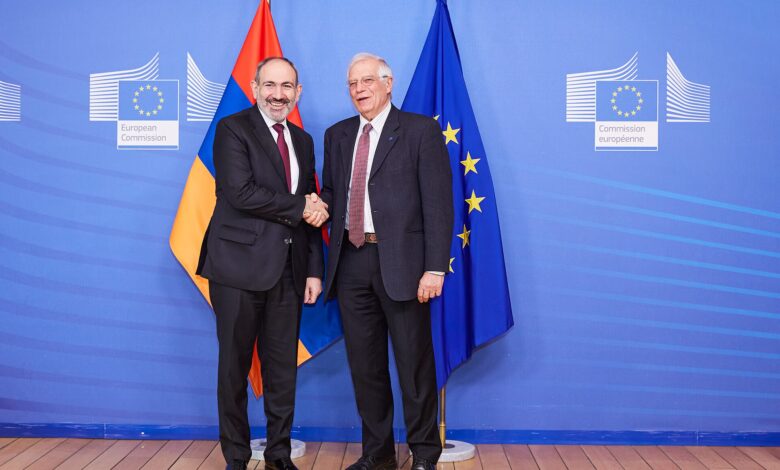
Armenia is preparing to begin the process of formally applying for membership in the European Union, Prime Minister Nikol Pashinyan has told parliament. The move would turn years of closer political cooperation with Europe into an official accession bid, while raising difficult questions about Armenia’s place in the Russia-led Eurasian Economic Union.
Pashinyan said on August 24 that an application is necessary before Armenia and the EU can determine whether membership is realistic and develop a roadmap. He did not announce a filing date, saying considerable preparatory work is still required.
From aspiration to formal process
Armenia’s parliament adopted a law in March 2025 launching a process oriented toward EU accession. At the first Armenia-EU summit in Yerevan in May 2026, European leaders acknowledged the country’s European aspirations and expanding cooperation.
A formal application would be a further step, but it would not make Armenia a candidate automatically. EU institutions would assess the request, member states would decide whether to grant candidate status and any negotiations would require reforms across the judiciary, competition policy, public administration, trade, environmental standards and democratic governance.
Accession normally takes years and ultimately requires unanimous approval from existing EU members. The process can stall or reverse if reforms are incomplete or political conditions change.
A referendum would come later
Pashinyan said a national referendum should be held only after the process reaches a meaningful stage and voters can judge a realistic offer and reform roadmap. Holding a vote before the EU responds could reduce a complex decision to an abstract geopolitical preference.
A later referendum would need clear information about costs, benefits, transition periods and alternatives. Voters should know which obligations are confirmed and which remain negotiating positions.
Public debate is likely to focus on economic opportunity, rule-of-law reform, travel and education as well as security. Membership does not provide an immediate solution to every regional risk, and the EU is not identical to NATO.
Tension with the Eurasian Economic Union
Armenia remains part of the Eurasian Economic Union with Russia, Belarus, Kazakhstan and Kyrgyzstan. Pashinyan criticised restrictions imposed by Russia on Armenian exports, saying they contradict the bloc’s rules and have created a crisis within the organisation.
Full participation in both the EU customs framework and the EAEU would be difficult because each has its own external tariffs, product rules and trade policy. Armenia may eventually face choices about alignment, transition arrangements and market access.
Russia is a major trading and security actor for Armenia, while the EU offers investment, regulatory integration and a larger market. A sustainable policy requires evaluating dependence and opportunity rather than treating either relationship as purely symbolic.
Regional implications
Armenia’s landlocked geography makes reliable transport through neighbouring countries essential. Progress in relations with Azerbaijan and Turkey could influence whether closer European economic integration produces practical gains. Borders, railways, electricity links and customs procedures matter as much as declarations.
The government must also ensure that foreign-policy realignment does not weaken domestic accountability. EU accession standards can support reform, but institutions improve only when laws are enforced consistently and citizens can scrutinise decisions.
A consequential but early step
The announcement marks a strategic shift because it moves the possibility of EU membership closer to a formal government act. It is still the beginning of a process, not a guarantee of candidate status or entry.
The next evidence will be the application itself, the EU’s response and a published roadmap explaining reforms and economic consequences. Transparent milestones would allow Armenians to judge progress without exaggerated promises from supporters or alarmist claims from opponents.
If Armenia proceeds, the decision will test whether a small state can diversify its alliances while managing deep economic and security links inherited from the post-Soviet system. The outcome will depend less on a single speech than on years of institutional change and regional diplomacy.




