
India curtailed nearly 11 TWh of solar power as grid bottlenecks grew

BENGALURU, September 2 — India curtailed nearly 11 terawatt-hours of solar generation over the past 15 months, according to government data and energy-system analysis, revealing how rapidly new clean capacity is outgrowing parts of the transmission and balancing system.
Curtailment means an available generator is instructed to reduce output. It does not imply that solar panels failed or that every unit could have been delivered instantly to a paying customer. Grid operators must continuously match production and demand while respecting transmission limits, reserves and equipment safety.
Why solar can be cut while demand is high
India’s highest demand increasingly extends into hot evenings, when air conditioners remain active but solar output falls. During sunny midday periods, certain regions can instead have more generation than local networks can carry or the national system can absorb safely.
Coal plants cannot always reduce output quickly or below their technical minimum. If transmission links are congested, storage is unavailable and flexible demand cannot move into the solar-rich hours, system operators may have to curtail renewable generation even though the country needs more electricity later the same day.
During April–June 2026 alone, the Ministry of New and Renewable Energy told Parliament that 8,133 gigawatt-hours of solar output was curtailed while national peak demand reached a record 270 gigawatts. The broader 15-month figure was reported in a September 2 assessment of India’s power system.
The scale and what it does not prove
Eleven terawatt-hours equals 11 billion kilowatt-hours. Comparing it with household use helps explain the magnitude, but it is not correct to claim that the same energy could have powered a fixed number of homes at all hours without transmission and storage.
Nor does curtailment show that adding solar is pointless. Solar reduces fuel use and daytime shortages when the grid can accept it. The emerging problem is sequencing: generation, transmission, storage, forecasting, market rules and flexible demand must expand together.
Where the solutions lie
Battery storage can absorb midday surpluses and discharge during evening peaks. Pumped hydro, stronger interstate transmission, more flexible thermal operation, time-of-day tariffs and industrial demand that responds to low-price hours can also reduce wasted output.
The Central Electricity Authority’s National Generation Adequacy Plan frames capacity needs over the next decade. Adequacy, however, is not only the total number of installed gigawatts: the system needs dependable energy at the right location and time.
India’s solar build-out has entered a more complicated phase. The policy test is no longer just how fast projects can be commissioned, but how much clean electricity can be moved, stored and used instead of being disconnected when it is most abundant.
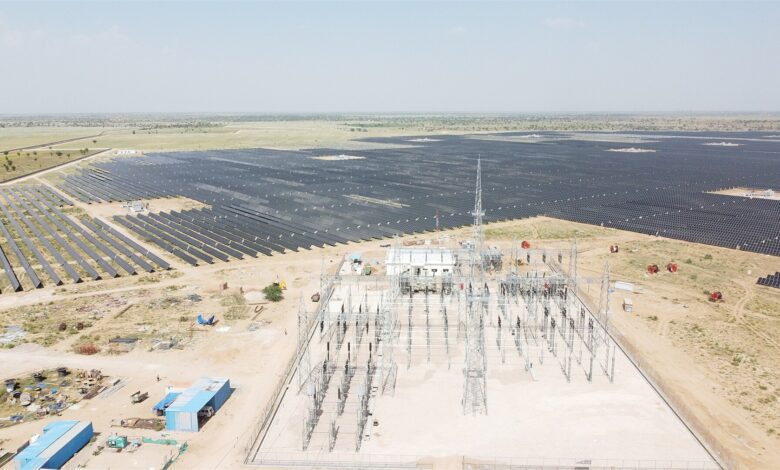
Archive photograph of the AMP Energy solar power plant at Bhadla, Rajasthan. Photo: Sarvajanik Puralekh, Wikimedia Commons, CC BY-SA 2.0.





