
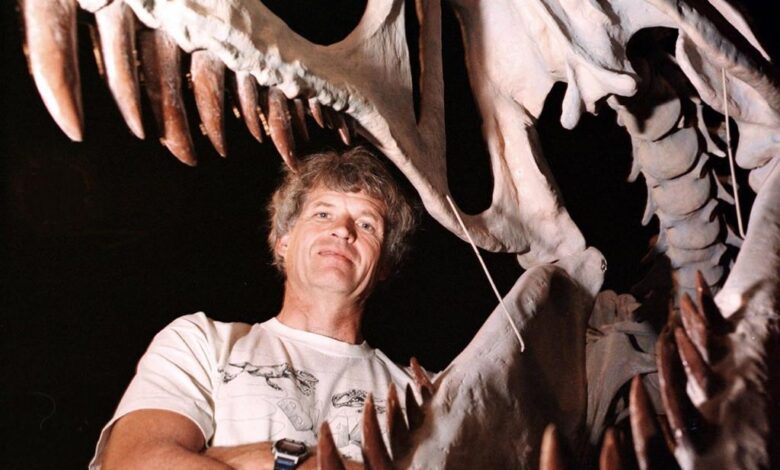
Canadian paleontologist Philip J. Currie marked his 75th birthday in 2024 with no intention of giving up fieldwork. After decades of discoveries in Alberta and expeditions across Asia, he said the enduring appeal of paleontology was that every answer exposed new gaps in humanity’s account of life on Earth.
A childhood ambition became a career
Currie traced his fascination to age 12, when a book by explorer Roy Chapman Andrews and visits to the Royal Ontario Museum convinced him that fossil hunting could be a life’s work. He later moved to Alberta, where rich Cretaceous deposits provided a vast natural laboratory.
He recalled finding his first dinosaur vertebra during fieldwork in the 1970s. The object was only one bone, but recognizing its anatomy, geological setting and relation to other fossils illustrated the detective work that would define his career.
Building Alberta’s fossil institutions
Currie was closely associated with the development of the Royal Tyrrell Museum of Palaeontology and later taught at the University of Alberta. The Philip J. Currie Dinosaur Museum in Wembley, named for him, brought the fossil history of northern Alberta to a wider public.
The Grande Prairie region is known for dense bonebeds of Pachyrhinosaurus, a horned dinosaur with a large bony boss on its skull. Such sites contain evidence about herd behaviour, growth and ancient environments, not merely impressive display specimens.
Research extended beyond Canada
Currie joined major expeditions in Mongolia and China, helping renew international study of dinosaurs and early birds. Comparing Asian and North American fossils allowed researchers to examine how animals dispersed across ancient land connections and how closely related species changed in different environments.
His work on feathered dinosaurs contributed to the now well-supported understanding that birds are living dinosaurs. That conclusion emerged from many fossils and researchers; it was strengthened by specimens preserving feathers and by detailed similarities in skeletons, eggs and behaviour.
The dinosaur he still hoped to find
Currie remained interested in finding a more complete animal historically called Troodon formosus. The small theropod is associated with relatively large brain capacity, forward-facing eyes and feathers, but fragmentary fossils have also produced a continuing taxonomic debate about which bones truly belong to that name.
That uncertainty is not a failure of science. A classification is revised when a better skeleton, new dating or a more rigorous comparison shows that material once grouped together represents different animals.
A link to popular culture
Jurassic Park author Michael Crichton acknowledged Currie’s research methods among the influences behind fictional paleontologist Alan Grant. The connection made Currie familiar beyond academic circles, although real field science proceeds far more slowly than a thriller.
Teams map a site, record the position of each specimen, remove rock carefully and spend months or years preparing and comparing bones. Geologists, anatomists, climate researchers, technicians and local field crews all contribute to a defensible interpretation.
Why the story remains incomplete
The fossil record is selective. Most organisms decay without leaving a trace, exposed bones can erode before discovery, and only a fraction of accessible rock has been searched. Even celebrated sites such as Dinosaur Provincial Park preserve particular environments and moments rather than a complete global catalogue.
Currie’s reflection was therefore both modest and optimistic. New fossils can overturn a familiar family tree or reveal behaviour that bones alone once seemed unable to show. The deeper lesson of his career is that paleontology advances by preserving evidence, sharing collections and remaining willing to revise a compelling story when the next discovery does not fit it.



