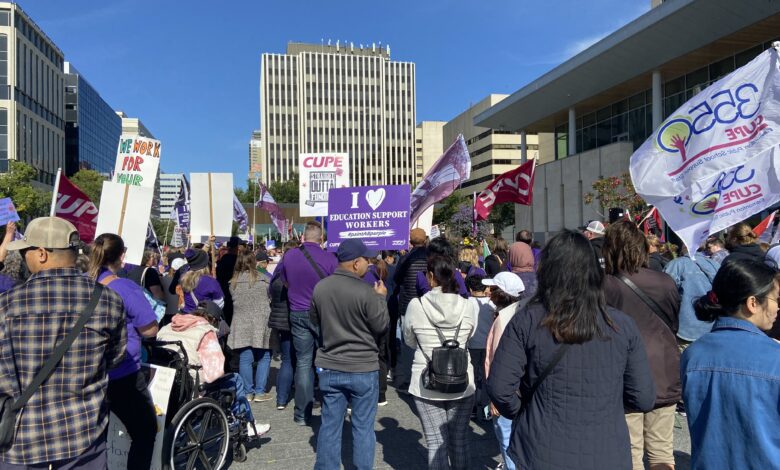
More than 200 Edmonton education-support workers rallied at the Alberta legislature on September 21, 2024, seeking higher wages and workable staffing levels. CUPE Local 3550, representing educational assistants, administrative staff and librarians, was negotiating a new agreement with Edmonton Public Schools.
Workers described stretched classrooms
Educational assistant Leeanne Cole-Fandrich said overcrowding and insufficient resources pulled her among three or four classrooms and sometimes caused missed breaks. Support workers help students stay focused, communicate, manage health needs and participate safely.
When positions remain vacant, the impact reaches teachers, families and especially students needing individual assistance.
Pay was a central demand
Local president Mandy Lamoureux said many members earned an average of about $27,000 annually and took second or third jobs to cover basic expenses. She said a proposed 2.75 per cent increase amounted to roughly 70 cents an hour for some workers.
Annual averages should be read with hours, months worked and job classifications, which vary.
The union challenged provincial influence
CUPE argued that Alberta’s wage mandate constrained local bargaining and objected to government intervention in disputes involving Fort McMurray school workers. The province said it did not bargain directly with CUPE and encouraged unions and divisions to use mediation.
School boards sign agreements, but provincial funding strongly shapes what they can offer.
Strike rights were already contested
Support staff in other divisions had served strike notice before the province appointed dispute inquiry boards. The intervention postponed job action while recommendations were developed.
Maintaining education continuity is important, but repeated intervention can weaken meaningful collective bargaining if underlying issues remain.
Rapid enrolment increased the pressure
Premier Danielle Smith said Alberta was adding about 33,000 students annually and announced accelerated capital construction. The province aimed to create 200,000 student spaces over seven years.
New buildings still need trained people; infrastructure funding cannot replace an operating workforce.
The province cited record investment
Education officials said billions were supporting enrolment growth and classroom complexity, including more than 3,000 teachers, assistants and other staff. Unions questioned whether those commitments matched population growth and produced sustainable wages.
Budget totals should be compared per student and adjusted for inflation.
Students bear the consequences
Low pay can drive turnover, disrupting relationships with children who depend on consistent support. A strike also disrupts learning and family routines.
That shared cost makes transparent, timely bargaining more urgent rather than a reason to silence workers.
A settlement needed measurable staffing outcomes
Fair compensation, clear workloads, adequate breaks, training and safe staffing ratios are connected. Governments and boards should report vacancies, turnover, student-to-support ratios and use of temporary staff.
The rally made often-invisible work visible. Whether its demands were affordable was a legitimate budget question, but whether schools could function without those workers was already answered daily. A durable agreement needed to value the roles sufficiently to recruit and retain people while ensuring every funded position reached the classroom.
Independent costing could help bridge the dispute by showing the total price of wage options alongside turnover, vacancy and training costs. Parents and workers then could evaluate a complete financial picture rather than competing headline percentages. Mediation works best when both sides have authority and reliable information to reach a settlement.