Does This Video Show an Injured Student at the Jantar Mantar Protests? No!

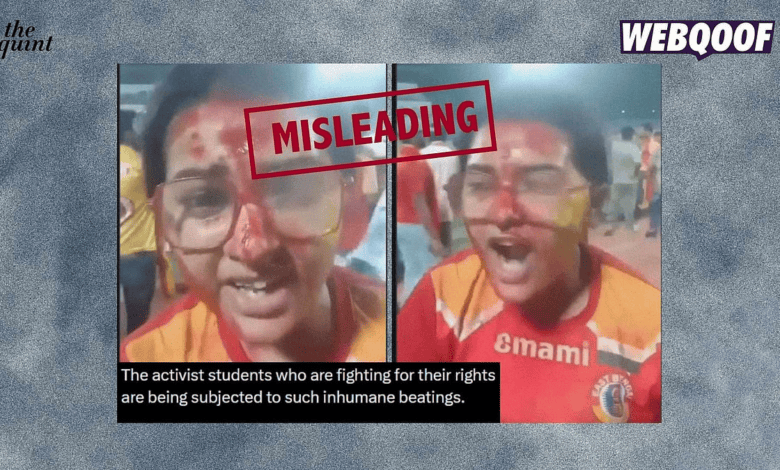
A viral video did not show an injured student at a Jantar Mantar protest, despite captions that linked the footage to the Cockroach Janta Party. The available visual and source evidence traces the clip to football supporter Zinia Debnath celebrating East Bengal FC’s Indian Super League championship in May 2026.
What the misleading post claimed
Social-media users circulated the clip as evidence that a student activist had been hurt during demonstrations in Delhi. The claim supplied a recent political setting but did not identify the purported student, establish when the injury occurred or provide an original upload from the protest.
Those missing details are warning signs. A video can be genuine while its caption is false. Reusing real footage with a new location, date or identity is often easier than fabricating an entire scene and can appear convincing when viewers already recognize the surrounding political controversy.
How the original context was located
Frames from the video were checked through reverse-image search. That led to social posts disputing the protest description and identifying the woman as an East Bengal supporter. Visible details within the clip supported that direction: she wore an East Bengal jersey, and the setting resembled a stadium rather than Jantar Mantar.
The strongest evidence was an earlier upload on Debnath’s own Instagram account dated May 22, 2026. Its caption celebrated East Bengal as ISL champion. The club had won the championship the previous day, creating a coherent timeline for the emotion shown in the video.
No equivalent evidence connected the clip to the protest claim. The earlier, attributable upload predates the political caption and explains the same imagery without relying on anonymous assertions.
What the evidence does and does not prove
The finding establishes that this particular video was miscaptioned. It does not determine whether any person was injured at a demonstration, whether protesters’ wider grievances were justified or how authorities handled a separate event. Those questions require their own evidence, including named witnesses, medical records, official statements and on-location reporting.
Likewise, identifying a football celebration does not imply that the person shown participated in spreading the false caption. People whose images are recycled are often unrelated to the claim and can face harassment when viewers mistake them for political actors.
A repeatable verification method
When a dramatic clip appears, capture several clear frames and search each one because different frames may have been indexed. Look for the earliest accessible upload rather than the most popular repost. Compare clothing, signage, architecture and audio with the claimed location, and check whether the date fits known events.
Accounts that merely repeat the same caption are not independent corroboration. A cluster of identical posts can originate from one source. Preference should go to a traceable original, direct participant, official record or reporting that explains how the media was authenticated.
In this case the combined timeline, jersey, stadium setting and original celebratory post outweigh the unsupported protest caption. The responsible conclusion is narrow but firm: the viral footage shows a football supporter celebrating East Bengal FC, not an injured student at the Jantar Mantar protests.
source