Unitree’s Wild IPO Swing Raises Questions About China’s Robotics Boom

Unitree Robotics has become the most vivid symbol of China’s humanoid-robot investment boom after a spectacular Shanghai market debut was followed by a fall of roughly 45 per cent from the stock’s peak. The reversal erased about $30 billion from the valuation reached during its opening surge and revived concerns that expectations for artificial intelligence and robotics are racing ahead of near-term earnings.
The Hangzhou-based company drew intense retail demand when its shares began trading on August 19. At one stage they stood about 629 per cent above the offer price, pushing Unitree’s value to approximately $66 billion before the retreat.
Why investors rushed in
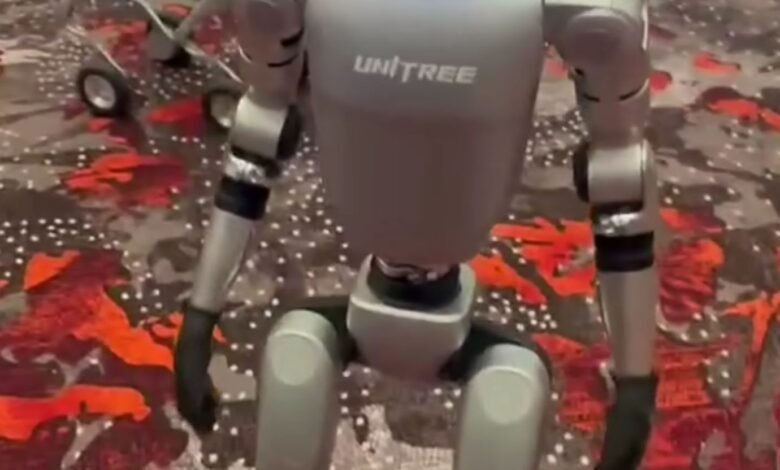
Unitree is known for four-legged machines and the G1 humanoid robot, products that have circulated widely in demonstrations and online videos. Its relatively visible brand gives public-market investors a direct way to participate in a sector that China has identified as strategically important.
Humanoid robots promise a general-purpose platform able to work in factories, warehouses and eventually service roles designed around the human body. Advances in batteries, motors, sensors and AI models have made the machines more capable, while manufacturers are trying to reduce their cost.
Those prospects can justify significant research investment. They do not establish how quickly customers will buy machines at scale, what maintenance will cost or whether manufacturers can sustain attractive margins in a competitive market.
Valuation meets financial reality
Unitree reported adjusted net profit of about 40 million yuan, or roughly $6 million, for the first quarter of 2026, a decline of 53 per cent from a year earlier. A single quarter does not define a high-growth business, but the direction is important when a market valuation assumes years of rapid expansion.
The gap between current profit and peak valuation means investors were paying primarily for future dominance. That can work if adoption accelerates and Unitree retains technical or manufacturing advantages. It also leaves the shares sensitive to any evidence of slower orders, higher costs, new competitors or safety and regulatory constraints.
The company had planned to raise about 4.2 billion yuan through the offering, selling at least 40.4 million shares. Capital from the listing can finance research, production and distribution, but access to funding does not guarantee that a commercial market will develop on the timetable reflected in the share price.
A broader test for China’s technology markets
Beijing wants domestic leaders in robotics, advanced chips and AI as competition with the United States shapes technology policy. Local governments and state-linked funds have supported laboratories, industrial parks and manufacturers, creating a deep supply chain and a large testing ground.
Policy support can speed innovation, yet it can also attract too much capital into similar companies. When investors assume that every strategic industry will produce a small number of protected champions, valuations can become detached from customer demand and cash flow.
Retail enthusiasm amplifies those movements. A limited initial share supply, high brand recognition and fear of missing a national technology success can send prices sharply higher. Once early buyers take profits, the same thin market can accelerate a decline.
What would justify the optimism
Unitree now has to demonstrate repeatable sales rather than impressive demonstrations. Investors should watch order quality, customer concentration, gross margins, warranty costs, production yield and how much revenue comes from research buyers compared with routine industrial users.
Safety and reliability will matter as robots move from controlled exhibitions into workplaces. A humanoid machine operating near people must respond predictably to faults, protect data and remain economical over thousands of hours. These requirements are less dramatic than a dance or sprint, but they determine whether customers make repeat purchases.
The fall does not prove that Unitree is weak or that humanoid robotics lacks a future. It shows that even a promising company can be a risky investment when price moves much faster than verified business performance.
China’s robotics sector may ultimately transform manufacturing and services. Unitree’s volatile first week is a reminder that technological importance and shareholder returns are different questions, and that a durable boom must eventually be supported by revenue, reliability and profit rather than excitement alone.